

FOLLOW‑UP: Maryland’s Geothermal Goldmine
A national industry comes to Baltimore — and hands the state a chance to lead
By Maryland Wire
Maryland didn’t go looking for a starring role in the next chapter of America’s clean‑energy transition. But sometimes the spotlight finds you anyway.
This March, Geothermal Rising — the national organization representing the country’s most ambitious thermal‑energy innovators — will bring its Thermal Energy Network Symposium to Baltimore. Not Boston. Not Denver. Not Salt Lake City. Baltimore.
The reason is simple: Maryland is now one of the most closely watched geothermal‑networking states in the country. The WARMTH Act, passed with little fanfare outside Annapolis, has quietly positioned Maryland as a proving ground for a technology that could reshape how American homes are heated and cooled.
And the industry has noticed.
A national conference lands in Maryland — because of Maryland
The decision to host the symposium in Baltimore wasn’t ceremonial. It was strategic.
Maryland is the first East Coast state to require utility‑scale geothermal network pilots. The industry wants to showcase those projects, study them, and — if the state follows through — point to Maryland as the place where the next generation of thermal infrastructure took shape.
For a governor who has made national visibility part of his governing style, the timing is impeccable. A high‑profile clean‑energy success story unfolding in Baltimore, with national industry leaders in the room, is the kind of moment that travels well beyond state lines. It’s the sort of policy win that resonates with audiences in other regions, including those that tend to pay close attention to early leadership on climate and infrastructure.
No declarations. No predictions. Just the reality that Maryland has an opportunity to look very good on a very big stage.
The PSC hits pause — and strengthens the pilots
Just days before the symposium announcement, the Public Service Commission issued a ruling on the geothermal pilot proposals from Washington Gas and BGE. Both utilities submitted plans that were promising but expensive — higher than what experts in other states have achieved.
Rather than reject the projects, the PSC ordered something more constructive:
Work with an independent consultant. Bring the costs down. Make the pilots buildable.
This is the same approach that helped Massachusetts and New York refine their early geothermal networks. It slows the timeline, but it increases the odds of success — and success is what Maryland needs if it wants to be the state the rest of the country studies.

Delegate Lorig Charkoudian, the architect of the WARMTH Act, welcomed the ruling. She sees it as a necessary step toward making geothermal networks a durable part of Maryland’s energy landscape. And she’s right: the first pilots must work, or the entire model falters.
Why Maryland is uniquely positioned to lead
Maryland’s geothermal moment isn’t accidental. It’s structural.
1. The right density
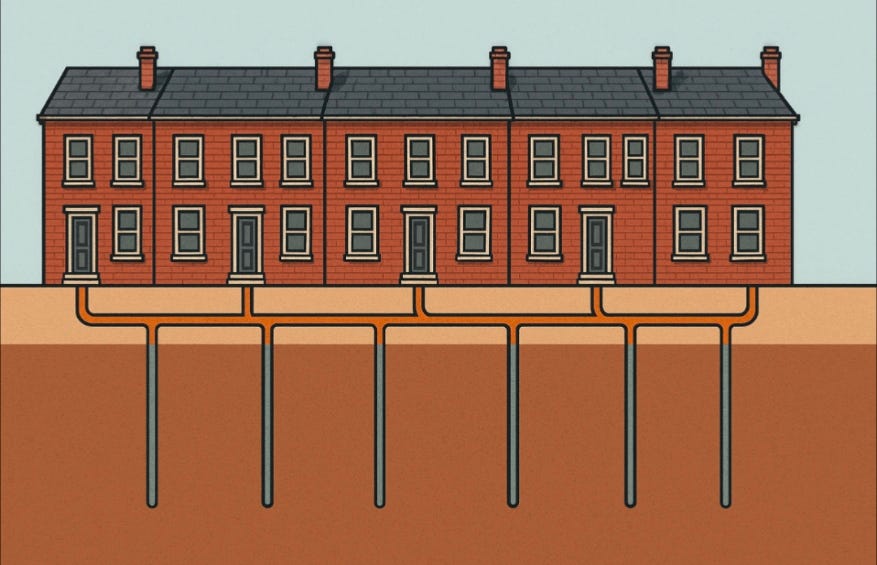
Geothermal networks thrive in neighborhoods where homes are close together and heating loads are predictable. Maryland’s built environment — from Baltimore rowhouses to suburban cul‑de‑sacs — is ideal.
2. The strongest climate mandates in the region
The Climate Solutions Now Act forces Maryland to decarbonize buildings faster than any neighboring state. Geothermal networks are one of the few scalable tools that can meet that mandate without political backlash.
3. A unified utility structure
Unlike Virginia’s fractured system or Pennsylvania’s patchwork of rural utilities, Maryland’s regulatory landscape is streamlined enough to support coordinated pilots.
4. A governor who understands the value of national attention
Maryland’s chief executive has consistently framed state achievements in ways that resonate beyond state borders. A successful geothermal pilot — especially one showcased at a national symposium in Baltimore — fits neatly into that pattern.
Again, no speculation. Just the observation that leaders who want their states to be seen as innovators tend to elevate moments like this.
The risk: letting the moment pass
Maryland has a habit of being early to an idea but late to the execution. Offshore wind. Transit modernization. Broadband expansion. The geothermal pilots could fall into that pattern if the state doesn’t push.
The PSC has done its part. The utilities now have marching orders. The industry is literally coming to Baltimore to cheer Maryland on.
What remains is the political will to turn a statutory requirement into a signature achievement.
The opportunity: a new energy identity for Maryland
If Maryland embraces this moment, the state could become the East Coast hub for thermal‑energy networks — an industry that promises:
- long‑term utility jobs
- lower heating and cooling costs
- reduced emissions
- modernized infrastructure
- and a national reputation for innovation
That last point matters. States rarely get the chance to define a new energy sector. Maryland has one now.
And with the nation’s geothermal leaders gathering in Baltimore this spring, the state has a platform ready‑made for a governor who wants Maryland to look bold, competent, and forward‑thinking on the national stage.
No need to say anything more than that. The implications speak for themselves.
