

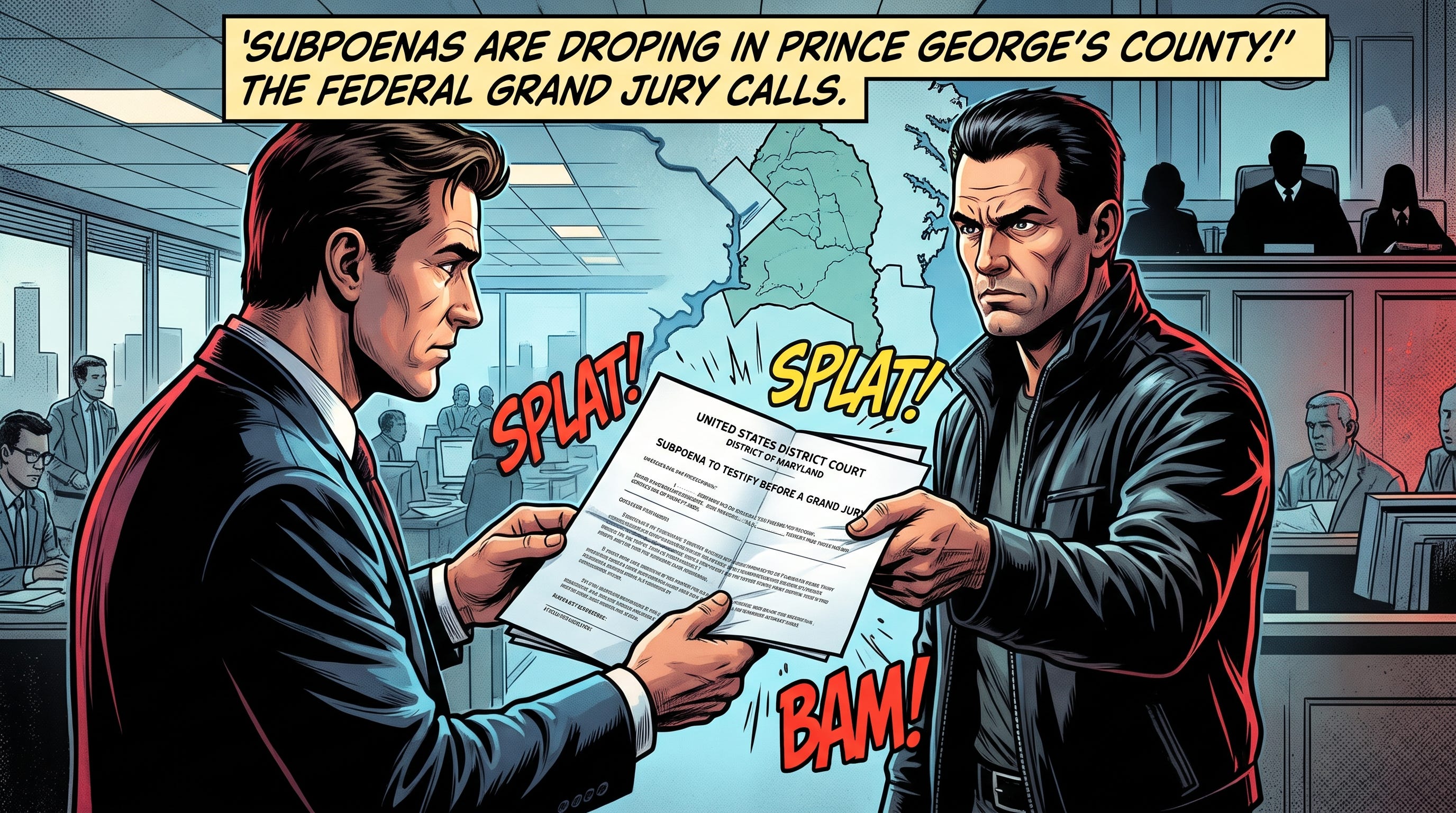
Sources: Federal Subpoenas Hit Prince George’s Staffers as Prosecutors Build Public Corruption Probe
ANNAPOLIS, Md. — A secret federal investigation into public corruption in Prince George’s County is gathering momentum, with federal grand jury subpoenas hitting lower-level government employees, political aides, and administrative staff, according to sources high up in state government and political circles speaking on the condition of anonymity.
The delivery of federal grand jury subpoenas to low-level staffers marks a classic "bottom-up" tactic used by the U.S. Attorney’s Office for the District of Maryland to build high-stakes public corruption cases.
Building from the Ground Up
Federal prosecutors and agents from the Federal Bureau of Investigation rarely start an investigation by targeting political figures directly. Instead, investigators issue subpoenas for testimony and documentation to subordinates—administrative assistants, procurement officers, mid-tier agency heads, and campaign aides.
These lower-level individuals are often subpoenaed to appear at the U.S. District Court in Greenbelt or to produce records regarding funding approvals, scheduling, communication logs, and internal decisions.
By locking in the sworn testimony of lower-level officials early, prosecutors lay the groundwork to catch higher-ranking targets in lies, discrepancies, or false statements during subsequent interviews.
Proffers, Immunity, and "Queen for a Day"
According to sources familiar with the federal process, prosecutors are actively utilizing proffer agreements—often called "Queen for a Day" agreements—to secure cooperation from low-level employees who may be caught in the web of the investigation.
Under a proffer agreement, a witness sits down with federal prosecutors and FBI agents to disclose everything they know about a suspected scheme. In exchange, the government agrees not to use the witness's statements directly against them in a prosecution, provided the witness tells the truth.
If the information provided is deemed truthful and valuable, federal prosecutors frequently extend formal letter immunity or non-prosecution agreements. This strategy eliminates a witness’s ability to claim the Fifth Amendment right against self-incrimination, effectively compelling them to testify against their superiors before a grand jury.
A Familiar Pattern in Prince George’s
Federal public corruption investigations in Prince George’s County have historically followed this exact playbook. Past federal probes involving former county executives, state delegates, and local municipal officials frequently relied on lower-level facilitators, contractors, and staffers cooperating under proffer agreements to map out paper trails and financial transactions before grand jury indictments were unsealed.
Federal grand jury proceedings are strictly confidential under Rule 6(e) of the Federal Rules of Criminal Procedure. The U.S. Attorney’s Office for the District of Maryland does not comment on the existence of ongoing grand jury investigations or the issuance of subpoenas.