

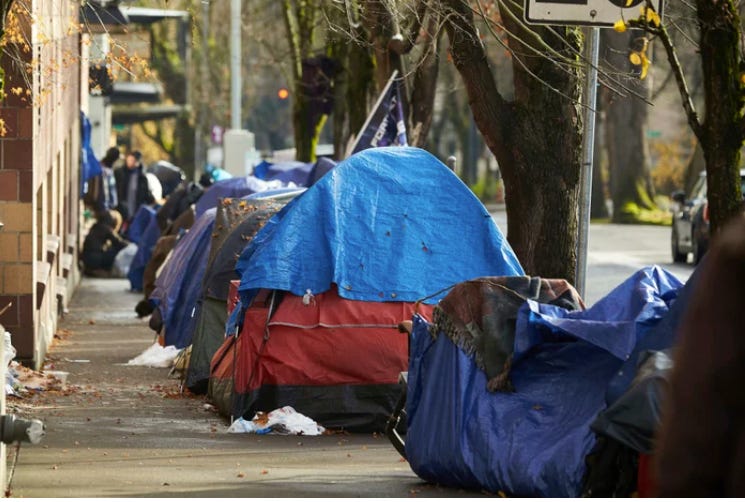
President Trump’s July 24 executive order, Ending Crime and Disorder on America’s Streets, has reignited a national debate about homelessness, mental illness, and civil liberties. For Maryland, the implications are both practical and philosophical. But to understand what’s at stake, we need to start somewhere else, Portland, Oregon.
🧍♂️ A Brother, a Cardboard Shelter, and a Family’s Heartache
A dear friend of mine lives in Portland. Her younger brother suffers from mental illness. Sometimes he stays at their parents’ home, he has a warm bed, good food, and people who love him. But inevitably, frustration builds. He leaves. He lives on the street, often in a pile of cardboard, in a city where homelessness is both visible and vast.
His family worries constantly. They know he’s vulnerable. They know he’s not safe. But they also know he’s an adult. He has rights. And no matter how much they love him, they can’t force him to stay. So they live in a state of suspended heartbreak—caught between compassion and helplessness.
This is not a theoretical dilemma. It’s real. And it’s happening in cities across America, including Baltimore, Hagerstown, and Salisbury.
⚖️ Does He Have a Right to Be There?
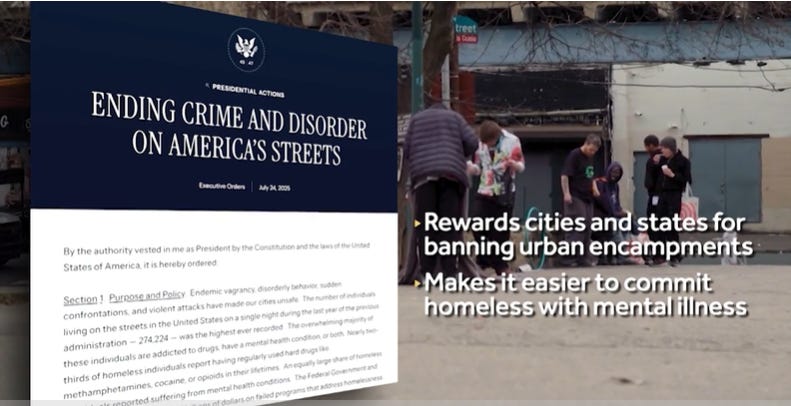
The constitutional question is thorny: Does someone have the right to live in a cardboard box and reject help? The Supreme Court’s 2024 ruling in Grants Pass v. Johnson says cities can ban public camping, even when shelter is unavailable. Trump’s executive order builds on that, encouraging civil commitment for those deemed unable to care for themselves.
But Maryland’s laws still require due process. A person must be a danger to themselves or others, and they’re entitled to a hearing. That’s a high bar—and for good reason. The right to refuse treatment, even when it seems irrational, is a cornerstone of civil liberty.
🏠 What This Means for Maryland
- Funding Pressure: Cities may feel compelled to adopt stricter ordinances to qualify for federal grants.
- Legal Complexity: Maryland’s constitution and civil commitment laws may clash with federal directives.
- Moral Ambiguity: Families like my friend’s face impossible choices. Do we honor autonomy or intervene for safety?
💬 A Policy That Misses the Human Element
Trump’s order is sweeping, expensive, and constitutionally vulnerable. It’s not the worst idea ever conceived—but it’s not a good one either. It treats homelessness as a public nuisance rather than a public health crisis. It assumes that institutionalization is a cure-all, ignoring the emotional and relational complexities that define real lives.
In Maryland, we must ask: Are we solving homelessness, or are we just hiding it? Because behind every encampment is a story like my friend’s, a family trying to love someone who doesn’t want to be saved.