

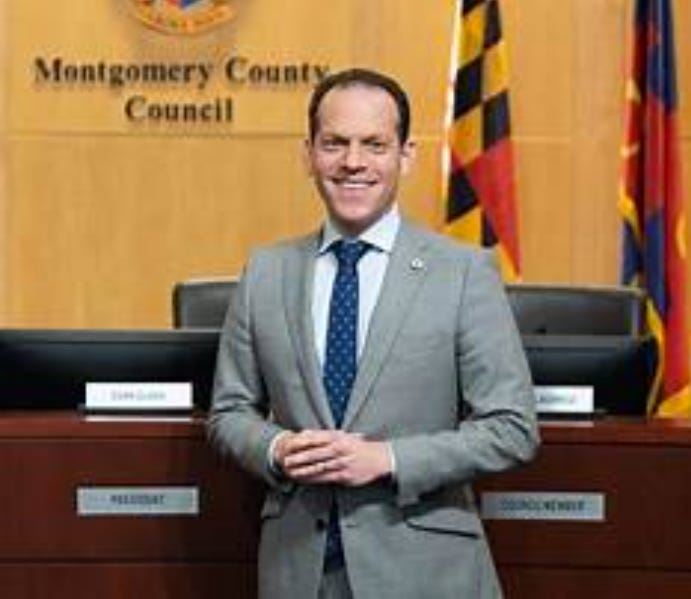
In the Montgomery County Executive Race, New Questions Emerge About Campaign Finance Transparency
In a race already defined by contrasts in style, experience, and governing philosophy, a new set of questions has quietly surfaced around the campaign finance filings of County Councilmember Evan Glass — questions that, at this stage, raise no allegation of wrongdoing, but do highlight the need for closer public scrutiny as the 2026 campaign accelerates.
The issue began with a simple observation: Glass’s most recent filing reports a calculated cash‑on‑hand balance of roughly $1.1 million. But when downloading the publicly available contribution data from the Maryland State Board of Elections’ MD CRIS system, the sum of itemized contributions appears to fall several hundred thousand dollars short of that figure.
Complicating the picture further, Glass’s committee has not yet reported any expenditures for 2026, at least not in the filings currently posted online.
None of this, on its own, proves anything improper. Maryland’s campaign finance database is a reporting system, not an auditing system. The state does not validate the math that campaigns submit, and it does not automatically flag missing expenditures or mismatched totals. If a treasurer enters incorrect numbers — or simply omits a category — the system will display those numbers as‑is.
That means discrepancies can arise for entirely benign reasons:
- A large carryover balance from the previous year
- Unposted amendments that have not yet appeared in the public database
- Loans, in‑kind contributions, or transfers that do not show up in the itemized contribution CSV
- Timing gaps between bank activity and reporting deadlines
At this stage, there is no evidence that Glass or his campaign has violated any law or regulation. What exists is a mathematical inconsistency that deserves clarification — the kind of routine transparency question that arises in every competitive race, especially when large sums of money are involved.
Campaign finance is one of the few areas where the public has a statutory right to see behind the curtain. When numbers don’t immediately line up, the appropriate response is not accusation, but inquiry. Voters deserve to understand how campaigns are funded, how money is spent, and whether the filings accurately reflect reality.
As the Montgomery County Executive race heats up, this is one of several areas where candidates — all candidates — will face increased scrutiny. Transparency is not a partisan issue, nor a factional one. It is a basic expectation of public service.
For now, the question is simple:
Do the reported numbers reflect the underlying financial activity?
Only the campaign — or a corrected filing — can answer that.
Until then, the discrepancy remains just that: a discrepancy. Not a scandal, not a charge, but a reminder that in a county where voters expect clean government, even small inconsistencies deserve a closer look.