

The Quiet Power of Eric L. Bryant: Civil Rights, Capitol Hill, and the Annapolis Corridor
In the fast-moving halls of Annapolis, political influence is often measured in access and committee agendas. But for Eric L. Bryant, effectiveness has always been anchored in a decades-long loop of trust, strategy, and dedicated service at the intersection of civil rights, law, and government relations.
A National Reach That Hits Home
Sometimes in Maryland policy circles, state-focused debates make it easy to forget the broad national resonance of our own political figures.
Just last week, while sitting in a restaurant down in Lexington County, South Carolina, my waiter introduced himself. The name sounded familiar, so I asked him to point to his nametag: Kweisi.
I asked, “Like the Congressman?”
A huge smile lit up his face, and he told me his parents had named him directly after Congressman Kweisi Mfume. It served as a vivid reminder that Kweisi isn’t just another member of the Maryland delegation—he remains a national civil rights icon whose impact spans generations, from leading the NAACP to shaping federal policy.
That connection matters when looking at Eric Bryant’s career. Eric’s history with Mfume goes back to 1991, when he first interned for the Congressman. Years later, when Mfume left Capitol Hill to take the helm as President and CEO of the national NAACP, Eric joined him in Baltimore to serve as Deputy Director of National Field Operations.
From the Front Lines to Annapolis and Back
Eric may carry a youthful energy that makes it easy to forget how long he has been in the arena, but his career reflects deep institutional experience. Following his legal training at the University of Maryland School of Law and his early years in civil rights advocacy, Eric transitioned into government relations. He spent more than 13 continuous years as a partner at Rifkin Weiner Livingston LLC (RWL), becoming a key player in state and local legislative strategy.
Yet when Congressman Elijah Cummings passed away in late 2019, creating a vacancy in Maryland’s 7th Congressional District, Eric stepped out of his law partnership to run Mfume’s campaign. After securing the seat, Eric returned to Capitol Hill to serve as Mfume’s Chief of Staff, guiding congressional operations through critical legislative cycles.
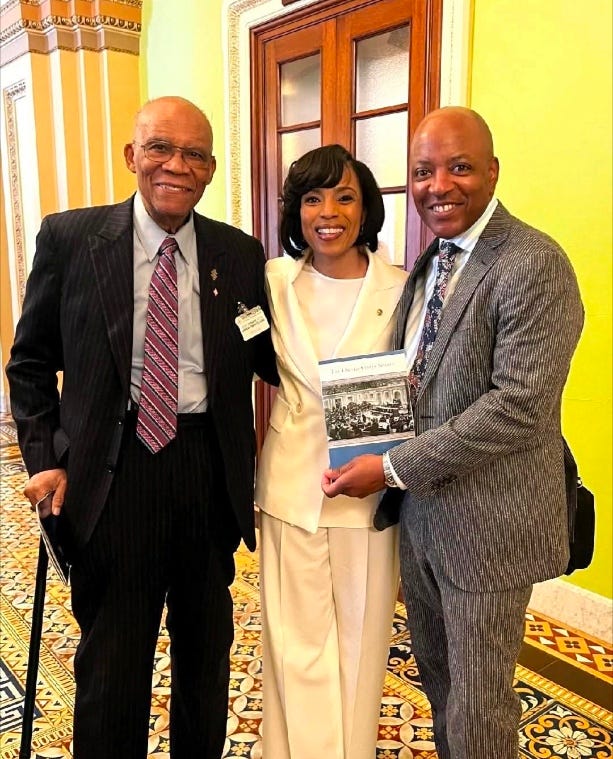
That longevity and deep trust within Maryland’s legal and political establishment was recently on display during a historic moment in Washington: a photograph captured Eric alongside University of Maryland law professor and civil rights icon Larry Gibson, standing on either side of Angela Alsobrooks on the day she was officially sworn into the United States Senate. Positioning alongside figures like Gibson at landmark events reflects the steady, trusted role Eric has cultivated across state and national politics.
Bridging Strategy and Public Service
Today, having completed his tenure on Capitol Hill and stepped into a key regulatory role on the Maryland State Board of Elections, Eric brings a rare combination of high-level campaign experience, civil rights advocacy, and administrative expertise to the table.
For the Annapolis advocacy community, he represents a unique bridge: someone who understands the high-minded mechanics of national movements, but knows precisely how policy and public service get built piece by piece.