

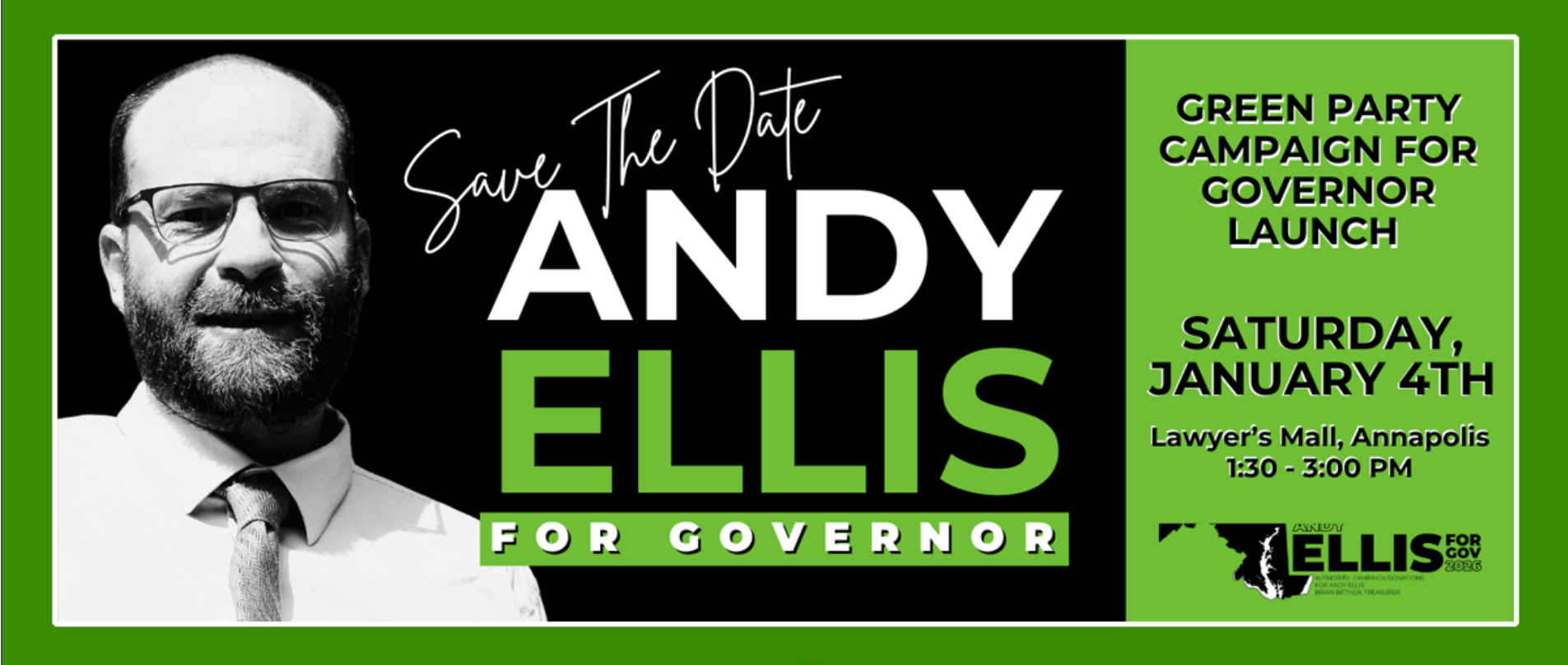
Ellis/Andrews Report Strong Early Fundraising — And Make Maryland History With Two Campaign Accounts
By Maryland Wire Staff
BALTIMORE — Maryland’s Green Party gubernatorial ticket is doing something small‑party campaigns almost never manage in statewide politics: posting fundraising numbers that look organized, sustainable, and—by Maryland third‑party standards—surprisingly competitive.
The Ellis/Andrews campaign reported $17,876.97 raised across 477 donations during the 2025 reporting period, with 204 unique donors and an average contribution of just $37.48. For a party that has historically struggled to break into five‑figure fundraising before Labor Day, the numbers represent one of the strongest early showings a Green gubernatorial ticket has posted in decades.
But the real story isn’t just the totals. It’s the two‑account structure the campaign is now running—one traditional campaign account and one newly opened publicly financed account under Maryland’s Fair Election Fund.
And that second account is historic.
A First for Maryland: A Small‑Party Ticket in the Public Financing System
When Owen Silverman Andrews joined the ticket as the Green Party’s candidate for lieutenant governor, the campaign opened a new Fair Election Fund account—making Ellis/Andrews the first small‑party statewide campaign in Maryland history to participate in the public financing program.
That account has already raised $7,082.76 from 126 donors, with 107 donors verified toward the state’s qualification threshold. To unlock matching funds, campaigns must hit 1,500 in‑state donors and $120,000 in qualifying contributions, with individual donations capped at $250.
At 7.1% of the donor requirement and 5% of the dollar threshold, the campaign is still early in the climb—but the structure matters. Public financing is designed to reward campaigns that can demonstrate broad grassroots support, and the Ellis/Andrews team is leaning heavily into that model.
“This campaign belongs to the people building it, one small donation at a time,” Andrews said in the release. “You don’t need wealthy backers to run a serious campaign for statewide office. You need neighbors who believe change is possible.”
Two Accounts, One Strategy
The dual‑account setup gives the campaign something unusual for a Green Party ticket: a traditional fundraising arm and a public‑financing‑eligible arm operating in parallel.
- The traditional account reflects the campaign’s broader donor universe and early organizing strength.
- The Fair Election Fund account reflects the campaign’s attempt to qualify for matching funds and build a donor base large enough to compete in a statewide environment dominated by Democrats and Republicans.
Together, the accounts paint a picture of a campaign trying to scale up in a way Maryland’s Green Party has rarely attempted.
Aiming for 100,000 Votes
The campaign says it is targeting 100,000 votes in November 2026, which would mark the strongest third‑party gubernatorial performance in Maryland since the Civil War era. That’s an ambitious benchmark, but the early fundraising numbers suggest the ticket is building the kind of infrastructure that could make a statewide impact—even if victory remains a long shot in a state where Democrats hold a significant registration advantage.
Andy Ellis framed the early momentum as proof that Maryland voters are open to something different.
“Two hundred people have stepped up to say they believe a different kind of politics is possible,” Ellis said. “When your average contribution is under forty dollars, you’re not beholden to special interests. You’re accountable to regular people.”
What It Means for Maryland’s 2026 Landscape
Maryland’s gubernatorial field is still taking shape, but the Ellis/Andrews report stands out for one reason: it shows a minor‑party ticket behaving like a major‑party campaign, with structured fundraising, a clear strategy, and a credible path toward public financing.
In a cycle where the major‑party frontrunner is already posting record‑breaking totals, the Green Party’s early numbers won’t change the balance of power. But they do signal something Maryland hasn’t seen in a while: a third‑party gubernatorial campaign that is organized, disciplined, and capable of building a real statewide footprint.
For a party that has long struggled for visibility—and for ballot access—this is the kind of early report that can reshape expectations.