

For the past five years, a patch of land off Joppa Road has been ground zero in one of Baltimore County’s fiercest fights over equity, development, and whose voice really matters when policy is written. At the heart of it stands the Red Maple Place housing proposal—a 56-unit affordable complex pitched by Homes for America, a nonprofit developer with political wind at its back and a HUD agreement to fulfill.
But if you think this is just a zoning dispute, you’re missing the soul of it.
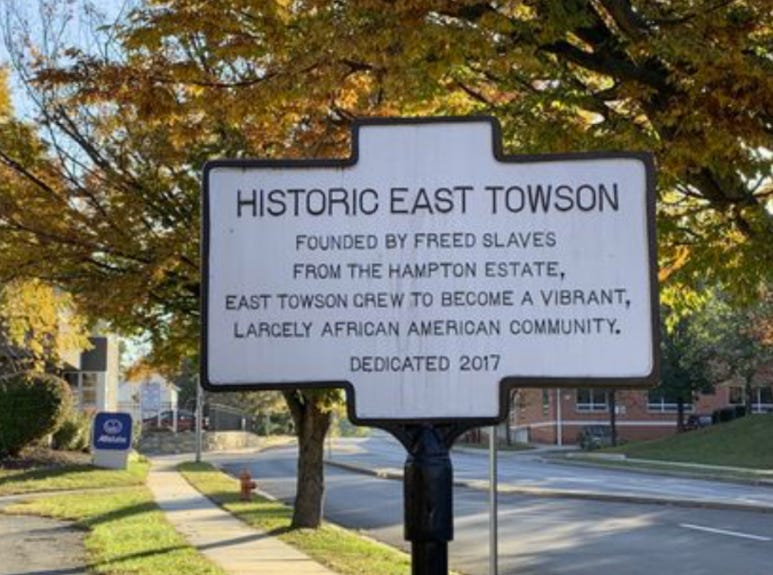
🏘️ East Towson: Maryland’s Black Historical Landmark in Living Form
East Towson isn’t just another residential neighborhood. It’s a living archive—a community founded by Freed Slaves and inhabited by the descendants of Black Americans enslaved at the nearby Hampton Plantation. After Emancipation, they carved out a piece of Towson for themselves, building homes, churches, and institutions that have stood for generations. There’s no statue to commemorate their struggle. Their story is in the soil.
To residents, Red Maple isn’t just another development. It’s an existential threat. Locals call it a “big brick beast,” one that’s out of scale, out of context, and out of touch with the community’s history. They point to environmental degradation—wetlands, runoff, flooding—and say the project scars the landscape. But the deeper issue isn’t about bricks. It’s about erasure.
Many feel this is a textbook example of “progress” steamrolling legacy. A federally mandated housing deal gets priority; the people who’ve lived on the land for over a century get sidelined. Public hearings have felt performative. Legal rulings have favored the developer. And while the building technically sits just outside East Towson, the symbolic encroachment is clear.
💰 The Council’s Rejection and Mike Ertel’s Role
This month, Council Chair Mike Ertel led a unanimous vote to reject an additional $2 million loan for Red Maple. That alone changed the political terrain.
Ertel said the project was overpriced—$450,000 per unit—and poorly located. He echoed what many East Towson residents have said for years: the land was wrong, the deal was weak, and the community was ignored. Some see this as leadership. Others say it’s too late.
It’s fair to ask what’s fueling Ertel’s stance. Principle? Pragmatism? Pressure from voters? After all, he supported the initial loan in 2019. His pivot now suggests either a reckoning with the community’s concerns or a strategic recalibration. Either way, the move is reverberating.
🥁 Who’s Really Being Served?
- Homes for America frames itself as a force for housing justice, fulfilling a federal obligation to correct decades of racial exclusion.
- Kathy Klausmeier, the County Executive, stands firm in support, citing long-term equity.
- East Towson residents argue the project delivers justice at their expense—displacing one historically marginalized group to accommodate another.
So who are the good guys? That depends on your lens.
If you view justice as a ledger, Red Maple tips the balance toward the underserved. If you view justice as preservation, East Towson is fighting to keep history intact. The real tragedy is that these two visions were pitted against each other, rather than coordinated.
Baltimore County had the chance to honor East Towson’s legacy and meet its housing goals. It chose conflict over collaboration. And now, as Red Maple’s developers seek new funding, the question remains:
Will the county finally treat Black historical communities like stakeholders—or just speed bumps on the road to redevelopment?