

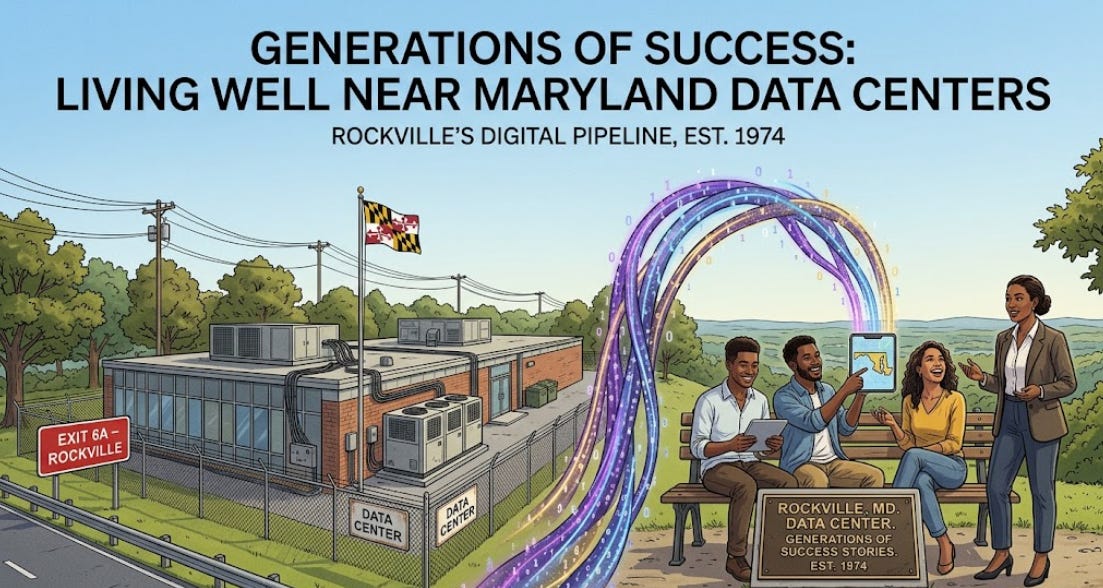
THEY WERE ALREADY HERE
Montgomery County’s Data Centers Were Hiding in Plain Sight
Before data centers became a political fight, an entire generation of future Maryland leaders was growing up around them. In 1999, future political figures were graduating from Springbrook, Montgomery Blair and Richard Montgomery while Montgomery County government was already documenting data-center operations in Rockville. They grew up. The data centers did too. Only one became a major political controversy.
THE CLASS OF ’99 HAD NO IDEA WHAT WAS COMING
Let’s go back to Montgomery County in 1999.
Bill Clinton was president.
Google was barely a year old.
Facebook didn’t exist.
The iPhone didn’t exist.
Artificial intelligence wasn’t something most Montgomery County families were discussing around the dinner table.
And an unusually accomplished collection of future Maryland political figures was worrying about something considerably more immediate:
Graduation.
Courtney Finklea Green was graduating from Springbrook High School, Class of 1999.
She would later become Maryland Deputy State Treasurer and, in 2024, was elected as a Democratic National Convention delegate from Maryland’s 5th Congressional District.
Official Maryland election results show Green receiving 73,976 votes, with the State Board of Elections marking her as one of the winning delegates. (Maryland Elections)
Across the county, Bernice Mireku—years before becoming Delegate Bernice Mireku-North—was graduating from Montgomery Blair High School, Class of 1999.
She would go on to represent Montgomery County’s District 14 in the Maryland House of Delegates.
Then there was Marc Korman.
Korman graduated from Richard Montgomery High School in Rockville in 1999.
Today, Delegate Korman represents Montgomery County’s District 16 and chairs the powerful House Environment and Transportation Committee. His official legislative biography confirms both his 1999 Richard Montgomery graduation and current chairmanship. (Maryland General Assembly)
And Korman’s graduation year produces an almost perfect piece of Montgomery County historical irony.
Because while the future chairman was graduating from high school in Rockville, Montgomery County government was publicly announcing that a company’s data-center operations would remain in Rockville.
Same city.
Same year.
Future legislator studying for finals.
Servers humming somewhere else in town.
Nobody handed Korman his diploma and said:
Congratulations, Marc. Welcome to the data-center economy.
And he wasn’t alone.
DATA CENTER FACE
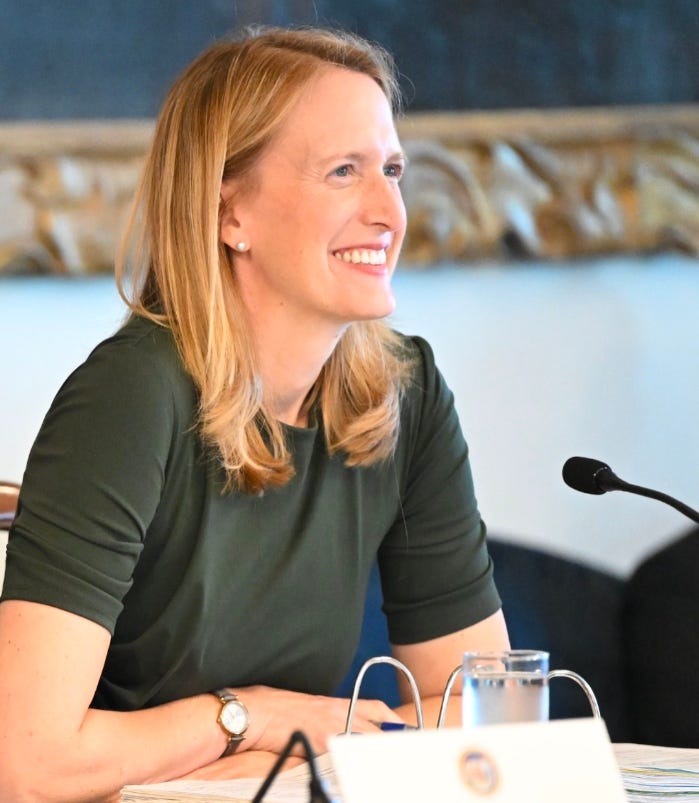
Typical Case of Data Center Face. Does Brooke look “Well Preserved” because of Long-Term Data Center Exposure?
MEET MONTGOMERY COUNTY’S DATA-CENTER GENERATION
The Class of ’99 is only part of the story.
Future Maryland Comptroller Brooke Lierman grew up in Montgomery County and attended Walt Whitman High School in Bethesda.
She would eventually become Maryland’s 34th Comptroller and the first woman independently elected to one of Maryland’s constitutional offices.
Future Maryland Senator Jeff Waldstreicher grew up in this same broader Montgomery County generation and attended Montgomery Blair High School.
He would eventually represent Montgomery County’s District 18 in the Maryland Senate.
Future Montgomery County Councilmember Will Jawando grew up in the Long Branch area of Silver Spring.
He would eventually become an at-large member of the Montgomery County Council.
And here history makes an almost perfect circle:
The Montgomery County kid who grew up while data infrastructure quietly existed around the county would eventually become a leading voice in the 2026 political debate over whether Montgomery County should temporarily stop additional data-center development.
The kids grew up.
The data centers grew up too.
Apparently only one became a political controversy.
MAYBE IT WAS SOMETHING IN THE SERVERS


Children raised near Data Centers seem to age slower and on average are SMARTER , BETTER LOOKING, and MORE SUCCESSFUL.
There is, of course, another possibility Montgomery County’s data-center studies appear to have completely overlooked.
Look at this group.
They’re accomplished.
They’re educated.
They’re politically active.
And several remain remarkably youthful-looking and spry decades after roaming the halls of Montgomery County Public Schools.
Coincidence?
Almost certainly.
But perhaps before Montgomery County bans anything, somebody should investigate whether growing up around 1990s computing infrastructure was actually the County’s original gifted-and-talented program.
Maybe it wasn’t the magnets.
Maybe it was the servers.
Before an entirely ridiculous rumor escapes onto Facebook, let’s establish something clearly:
There is absolutely no scientific evidence that growing up in the general vicinity of data infrastructure makes anyone younger-looking, smarter, more energetic or more likely to become a Maryland politician.
None.
Zero.
Please do not begin relocating children next to server racks.
Still…
For a Montgomery County generation that produced a state comptroller, state legislators, committee leaders, a county councilmember, a deputy state treasurer and an elected Democratic National Convention delegate, the cohort turned out rather well.
The Class of ‘99 isn’t exactly hurting the completely unscientific theory.
But beneath the joke is a serious question:
How could an entire generation grow up in Montgomery County without data centers becoming a major public issue?
The answer explains much of today’s controversy.
THE DATA CENTERS WEREN’T SECRET
Let’s establish an important distinction.
There is no evidence Montgomery County government secretly concealed data centers from residents.
The companies knew they existed.
Government knew.
Planning officials knew.
Institutions operating computing infrastructure knew.
Most residents simply had little reason to know or care.
And Montgomery County’s own records provide the receipt.
THE RECEIPT FROM 1999
On February 5, 1999, Montgomery County announced that GE Information Services would relocate its global headquarters within Montgomery County.
The company was moving from two buildings in Rockville into approximately 341,000 square feet of office and research-and-development space in Gaithersburg.
The relocation allowed GE Information Services to consolidate its headquarters.
But then came one fascinating sentence:
“The company’s data center operations will remain in Rockville.”
There it is.
1999.
Twenty-seven years before Montgomery County’s 2026 data-center fight, County government itself was publicly acknowledging data-center operations in Rockville. (Montgomery County MD)
And Montgomery County’s April 1999 official financial statement provides additional context about just how technologically concentrated the I-270 corridor had become. It identifies GE Information Services’ move, NASD’s planned 450,000-square-foot consolidated Rockville facility, Celera Genomics’ 200,000-square-foot Rockville facility and other major technology and biotechnology investments. (Montgomery County Government)
So the question isn’t:
When did data centers arrive in Montgomery County?
A better question is:
When did Montgomery County residents start noticing them?
MONTGOMERY COUNTY HAD DATA CENTERS—JUST NOT TODAY’S KIND
Historical Montgomery County Planning research provides an important distinction.
As commercial data centers proliferated in Northern Virginia during the internet boom, Montgomery County had a different technology footprint.
Companies and institutions could maintain proprietary computing and data-center infrastructure without Montgomery County developing anything approaching Northern Virginia’s enormous commercial data-center industry.
That’s crucial.
Northern Virginia was building a data-center industry.
Montgomery County had data-center infrastructure.
A corporation could operate its own facility.
A university could maintain servers.
Government could operate computing infrastructure.
An institution could have a dedicated center supporting its own operations.
To an ordinary resident driving past, there might be nothing remarkable to see.
Montgomery County had the computers.
Virginia was building the industry.
BACK THEN, A DATA CENTER DIDN’T MEAN WHAT IT MEANS TODAY
That is the key to understanding why Montgomery County residents weren’t marching against them in 1999.
The political meaning of the words “data center” has changed.
The modern debate increasingly involves hyperscale facilities supporting cloud computing, artificial intelligence and massive quantities of digital information.
And scale changes everything.
Today’s residents reasonably want to know:
How much electricity will they consume?
Will additional transmission infrastructure be necessary?
Who pays for those improvements?
How much water could cooling require?
What about noise?
Backup generators?
Environmental effects?
Where should enormous facilities be permitted?
What happens when one is proposed near homes, schools or environmentally sensitive land?
Those aren’t questions most Montgomery County families had any reason to ask about a corporate computing operation in 1999.
WHY CITIZENS CARE NOW
So the explanation for the apparent contradiction isn’t that Montgomery County suddenly became hostile to technology.
The technology became harder to ignore.
A relatively unobtrusive proprietary facility supporting one corporation is one thing.
A hyperscale campus potentially requiring enormous electrical capacity is another.
The old data center might have been technological plumbing.
The new one can become an infrastructure decision affecting an entire community.
Visibility follows scale.
And once residents began contemplating what the next generation could mean for electricity, water, land and infrastructure, the politics changed.
Fast.
FROM THE DOT-COM ERA TO MORATORIUM
The transformation is remarkable.
At the turn of the century, data infrastructure was associated with Montgomery County’s emergence as a technology and biotechnology powerhouse.
By 2026, County officials and residents were debating whether new data-center development should temporarily stop while Montgomery County figured out what rules should govern it.
Suddenly there were debates about zoning.
Environmental effects.
Electricity.
Water.
Generators.
The Agricultural Reserve.
And whether the County’s existing laws were adequate for facilities fundamentally larger than the proprietary centers of an earlier era.
The data center had gone from background infrastructure to front-page politics.
WAIT—THEY’RE ALREADY HERE?
Then came another important realization during Montgomery County’s 2026 debate.
Planning officials identified existing data centers already operating in Montgomery County, even as officials were debating how the County should regulate the next generation.
That is perhaps the simplest way to understand this entire story:
The data centers didn’t suddenly appear.
Public awareness did.
ROCKVILLE: THE CLEAREST HISTORICAL LOCATION
There is not yet enough historical public documentation to responsibly declare that Rockville had more data centers than every other Montgomery County community during the 1990s.
A complete city-by-city historical inventory simply isn’t available in the records reviewed for this article.
But Rockville is the clearest documented early location.
We know GE Information Services maintained data-center operations there in 1999 because Montgomery County said so itself. (Montgomery County MD)
And Rockville sat at the heart of the extraordinary I-270 technology corridor.
Montgomery County’s own 1999 financial documentation describes major technology and biotechnology operations around Rockville and Gaithersburg, including GE Information Services, NASD, Celera Genomics and The Institute for Genomic Research. (Montgomery County Government)
That makes the geography of the Class of ’99 particularly interesting.
Springbrook.
Montgomery Blair.
Richard Montgomery.
Future political leaders were growing up across Montgomery County at exactly the moment the County’s technology economy was exploding.
They just weren’t calling themselves the Data-Center Generation.
GOVERNMENT KNEW. CITIZENS MOSTLY HAD NO REASON TO.
That distinction matters.
Something can be publicly disclosed without becoming part of public consciousness.
Montgomery County publicly acknowledged GE’s data-center operations.
Planning officials understood the infrastructure.
Companies maintained it.
Institutions depended on it.
But why would the average Montgomery County parent in 1999 search government documents to determine where computer servers were housed?
There was no major controversy compelling them to.
For most residents, data centers were essentially technological plumbing.
Nobody spends much time thinking about the plumbing until somebody proposes installing a pipe the size of a highway.
That is essentially what happened to the politics of data centers.
AND NOW THE DATA-CENTER GENERATION IS RUNNING THINGS
There is something wonderfully Montgomery County about the historical circle.
The young people attending Montgomery County high schools during the technology boom didn’t disappear.
They grew up and entered public life.
The Springbrook graduate became Deputy State Treasurer and an elected Democratic National Convention delegate. Maryland’s official 2024 results show Green winning her District 5 delegate position with 73,976 votes. (Maryland Elections)
The Blair graduate became a Maryland delegate.
The Richard Montgomery graduate became chairman of the House Environment and Transportation Committee. (Maryland General Assembly)
The Whitman graduate became Comptroller of Maryland.
Another Blair graduate became a state senator.
The Silver Spring kid became a Montgomery County Councilmember involved in the modern data-center debate.
Meanwhile, the technology that had been humming quietly in their childhood county evolved into infrastructure powerful enough to trigger one of Montgomery County’s most consequential modern land-use debates.
That isn’t evidence that any of these individuals personally knew—or didn’t know—where a particular data center was located.
That’s precisely the point.
There was little reason for an ordinary teenager—or most ordinary adults—to notice.
THE REAL QUESTION ISN’T WHETHER MONTGOMERY COUNTY SHOULD HAVE DATA CENTERS
That question is decades late.
Montgomery County already has them.
The more important questions are:
How many operate today?
Where exactly are they?
How large are they?
How much electricity do they consume?
How much water do they use?
How were older facilities classified under County zoning?
How should institutional or proprietary centers be distinguished from hyperscale AI facilities?
What infrastructure should developers—not residential ratepayers—be responsible for funding?
And ultimately:
How big is Montgomery County willing to let the next generation become?
Those are the questions residents deserve answered.
THEY WERE ALREADY HERE
Montgomery County didn’t discover data centers in 2026.
It discovered what data centers could become.
In 1999, GE Information Services maintained data-center operations in Rockville while a generation of future Maryland political figures was coming of age in Montgomery County. The County’s own contemporary records establish both the Rockville data-center operation and the remarkable technology expansion occurring along the I-270 corridor. (Montgomery County MD)
Courtney Finklea Green graduated from Springbrook.
Bernice Mireku-North graduated from Montgomery Blair.
Marc Korman graduated from Richard Montgomery—in Rockville itself.
Brooke Lierman, Jeff Waldstreicher, Will Jawando and thousands of others belonged to the broader Montgomery County generation growing up alongside a technology economy that was quietly transforming their home county.
Some became lawyers.
Some became legislators.
One became Comptroller.
One became Deputy State Treasurer.
One won election as a Democratic National Convention delegate with nearly 74,000 votes. (Maryland Elections)
And some would eventually find themselves debating the future of the very category of infrastructure that had existed quietly in the background of their youth.
Back then, teenagers worried about graduation.
Adults worried about the dot-com economy.
The servers hummed.
Most citizens had no particular reason to notice.
Twenty-seven years later?
Everybody is talking about them.
And that may be the central lesson of Montgomery County’s forgotten data-center history:
The data centers didn’t suddenly arrive.
They got bigger.
So did Montgomery County’s Class of ’99.
Judging by the latter, apparently pretty well.
SOURCES & DOCUMENTATION
Montgomery County Government — “GE Information Services Relocates in Montgomery County,” February 5, 1999. The County’s contemporaneous announcement states that GE Information Services was relocating its global headquarters to 341,000 square feet in Gaithersburg while its data-center operations would remain in Rockville. (Montgomery County MD)
Montgomery County, Maryland — Official Statement, April 21, 1999. The County’s financial disclosure provides contemporaneous documentation of the technology boom along the I-270 corridor, including GE Information Services, NASD, Celera Genomics and other major technology and biotechnology operations. (Montgomery County Government)
Maryland General Assembly — 2026 Roster and Committee Assignments. The official legislative biography confirms that Marc Korman was born in Montgomery County, graduated from Richard Montgomery High School in Rockville in 1999 and serves as chair of the House Environment and Transportation Committee. (Maryland General Assembly)
Maryland State Board of Elections — Official 2024 Presidential Primary Election Results, Democratic National Convention Delegates, District 5. Official results identify Courtney Finklea Green as a winning Biden delegate with 73,976 votes (11.45%). (Maryland Elections)
Additional primary-source documentation used for the broader historical article: Montgomery County Planning’s information-technology industry research; Montgomery County Council’s 2026 data-center legislation and staff reports; Montgomery County Executive data-center community materials; Maryland General Assembly member biographies; Maryland State Archives biographical records; Montgomery County Public Schools historical materials; and Montgomery History’s oral-history collection.
Editorial note: Courtney Finklea Green’s Springbrook High School Class of 1999 information is biographical information supplied for this article. Her 2024 election as a Democratic National Convention delegate is independently verified by the Maryland State Board of Elections. (Maryland Elections)
Barry, you take the fun of hysteria and hypocrisy out of knee-jerk liberal politics. Shame on you.