

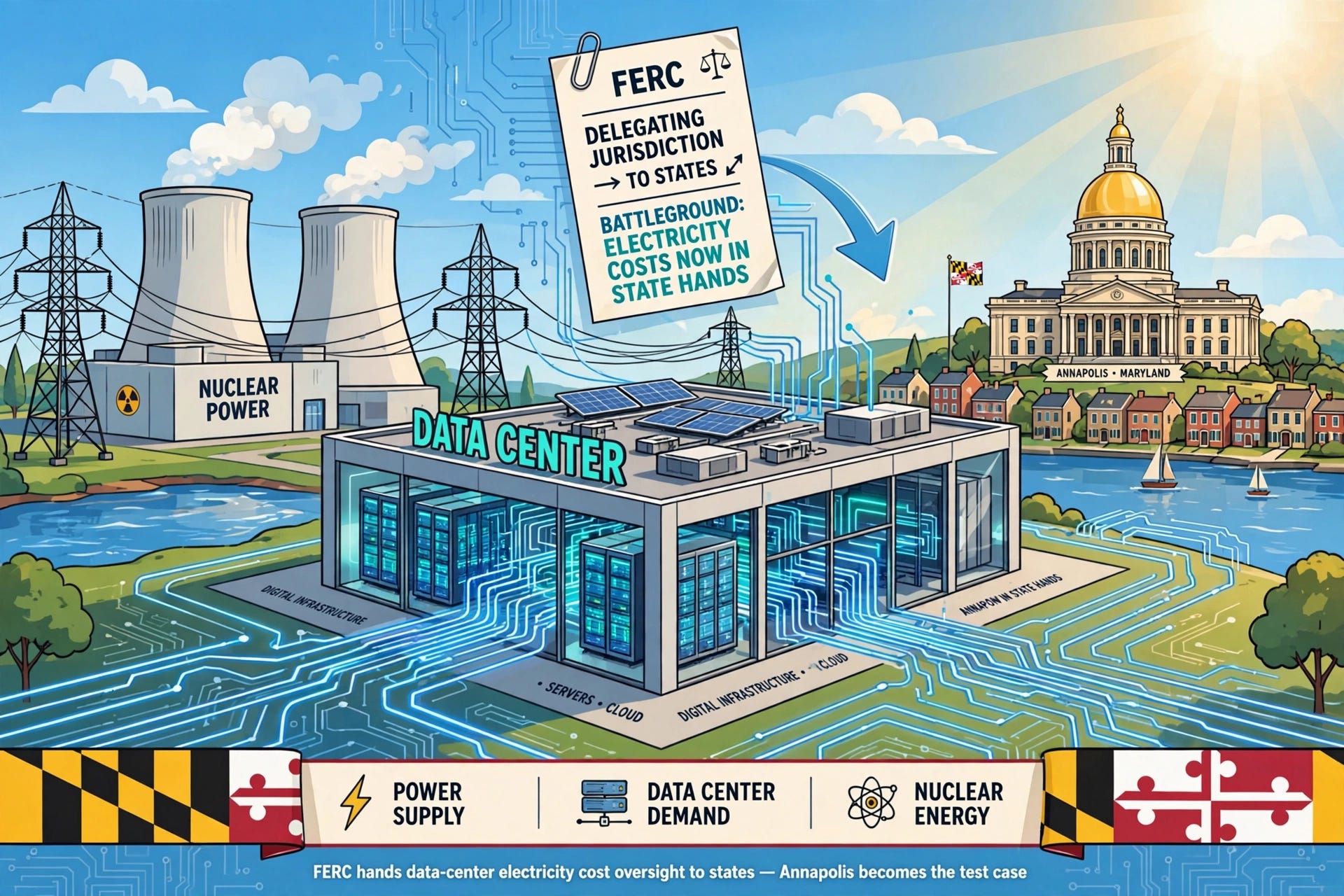
FERC Punted. Now the Fight Is in Annapolis.
The feds just handed the data-center question to the states. The 2027 session will decide who pays — and whose lights stay on first. The people who will work that fight are already registered, already paid, and already in the hallways.
On the evening of Friday, October 9, while nobody in Annapolis was watching, the Federal Energy Regulatory Commission voted 5-0 to hand the hardest question in American energy policy to the states.
FERC threw out almost everything PJM had proposed for managing the data-center load flooding its grid — the interim curtailment plan, the bring-your-own-capacity option, the demand-curve carve-out. What it kept was the registry: a list of every large load, 50 megawatts and up, existing and new, effective October 12. A list is not a plan. It is an admission that you need one.
The reasoning is the part that matters here. FERC said the rejected pieces put obligations directly on large loads that are, for the most part, retail customers — and that the compensation framework looked like a retail rate. Translation: this is state turf, not ours. “We do not take this decision lightly,” the commissioners wrote, “but states have a crucial role to play in this challenge by designating which retail customers must be curtailed when the system is stressed, and we strongly encourage states to continue their important work on this issue.”
FERC Told The States to Write The Law
Read that again. FERC just told the states to write the law that decides who gets shut off first when the grid is stressed. In Maryland, that means the General Assembly. It means the 2027 session. The fight over who pays for the grid just became the main event of that session — and the industry’s side of it is already on the field.
