

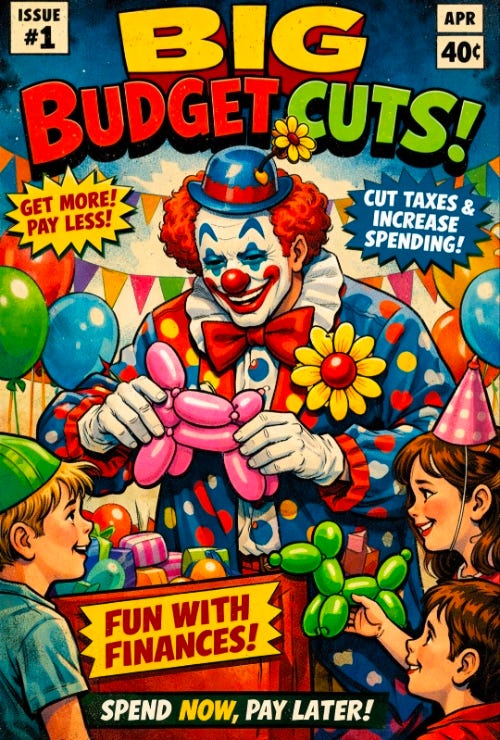
The Balloon Problem: What Dan Cox’s Tax‑Cut Promises Actually Mean for Maryland’s Budget
Maryland’s budget is a balloon. Squeeze one side, the other bulges. Reduce pressure on one part, the rest expands. And if you squeeze hard enough — as the tax‑cut package aligned with Dan Cox’s campaign would — the balloon doesn’t shrink. It simply bulges somewhere else until something bursts.
Cox has made several clear tax‑cut promises:
- Eliminate residential property taxes
- Eliminate taxes on retirement income
- Cut taxes and fees broadly to reduce cost of living
- Lower energy‑related taxes and fees
These promises do not come with fiscal estimates from Cox himself. But the Maryland General Assembly has already costed out a tax‑cut package — HB 133 — that mirrors the scale and structure of the cuts Cox is campaigning on.
HB 133 is not Cox’s bill. But it is the only detailed numerical model available for the type of tax‑cut agenda he is promoting.
And the numbers are not small.
The HB 133 Model: A 13.3 Billion Dollar Hole
HB 133 proposes:
- 3% flat income tax
- 3% corporate tax
- 3% sales tax
- Repeal of the 3% tax on IT/data services
- Capital gains changes
The official fiscal note estimates:
- $13.3 billion loss in General Fund revenue in FY 2027
- $843 million loss in Special Funds
Maryland’s General Fund is roughly $25–26 billion. HB 133 would remove more than half of that.
Even if Cox’s personal plan is smaller, his stated promises — eliminating residential property taxes and retirement taxes — would still remove billions from the revenue base.
This is where the balloon analogy becomes unavoidable.
The Balloon: What Happens When You Remove $13 Billion of Air
Budgets don’t shrink because you squeeze them. They shrink because you let air out — meaning you cut spending. If you don’t cut spending, the balloon bulges somewhere else — meaning you must raise other taxes.
There are only three ways to fill a $13 billion hole:
1. Raise other taxes — massively
If Cox eliminates residential property taxes and retirement taxes, the remaining taxes must rise to compensate.
Which ones?
- Income tax — already targeted for reduction
- Sales tax — HB 133 cuts it
- Corporate tax — HB 133 cuts it
- Gas tax — politically toxic
- Vehicle registration fees — regressive
- Fishing and hunting licenses — we joke about $100,000 fishing licenses, but mathematically, that’s the scale required
If you remove half the balloon’s air, the remaining half must expand. There is no scenario where taxes simply vanish without others rising.
2. Cut spending — deeply and visibly
Maryland’s budget is dominated by a few categories:
- Education (60%)
- Public safety (21%)
- Health and human services
- Transportation
- Environmental and infrastructure projects
To cut $13 billion, you cannot trim “fraud and waste.” You must cut programs people rely on.
Which ones does Dan Plan To Cut?
- Special needs assistance — already protested this year by families who brought children in wheelchairs to the Capitol
- Medicaid services
- School funding formulas
- University system budgets
- Corrections — meaning earlier releases or reduced staffing
- Highway maintenance
- Bridge replacement projects
- Broadband expansion — including rural Republican counties
These are not hypotheticals. They are the only large pots of money available.
3. Do both — raise taxes and cut spending
This is the most realistic outcome of a large tax‑cut package:
- Some taxes rise
- Some programs shrink
- Some fees increase
- Some services degrade
The balloon analogy again: squeeze one side, the other bulges. Squeeze both sides, the balloon collapses.
The Accountability Question: What Does Cox Plan to Do About the Hole?
Cox has not explained how he would offset the revenue loss from eliminating residential property taxes and retirement taxes.
He has not said:
- Which taxes he would raise
- Which programs he would cut
- Which services he would eliminate
- Which infrastructure projects he would shelve
- Which counties would lose funding
- Which agencies would shrink
- Which fees would increase
He has not provided a numerical plan.
HB 133 does provide numbers — and those numbers show a $13 billion shortfall.
If Cox’s plan is smaller, he can say so.
If his plan is different, he can say so.
If he has a way to fill the hole, he can explain it.
Marylanders deserve to know which part of the balloon he intends to squeeze — and which part he expects to bulge.
The Core Question for Voters and Legislators
If Maryland removes billions in taxes, who gets squeezed?
- Families with special‑needs children?
- Rural broadband users?
- Highway commuters?
- Bridge replacement projects?
- Prison staffing?
- School districts?
- Hospitals?
- Counties already underwater?
Or does Cox intend to raise other taxes — and if so, which ones?
This is not ideology. It is arithmetic.
Budgets are like balloons.
If you squeeze one side, the other bulges.
If you squeeze too hard, something bursts.
If you want the balloon smaller, you must let air out — meaning you must cut spending.
Maryland deserves a clear explanation of where the air will come out.
If Dan Cox has that explanation, Maryland Wire will publish it.
Sure give me thousands and thousands of dollars in tax cuts. In order to do that, how many teachers will be cut? What other services will be unfunded? I live in Maryland because it is a good place to live. We all would like lower taxes, but we also want to live in a community that offers a good quality of life. Mr. Cox's campaign promises are not realistic. Maryland is not Louisiana,West Virginia, or Florida.
moore importantly, what will incumbent moore cut ? to help Marylanders that he has already imposed higher taxes, and fees ??
Cox would do no worse .. imho