

MARYLAND WIRE — ANALYSIS
Dan Cox Says the Votes Are There. The Math Says Something Else.
By Barry O’Connell
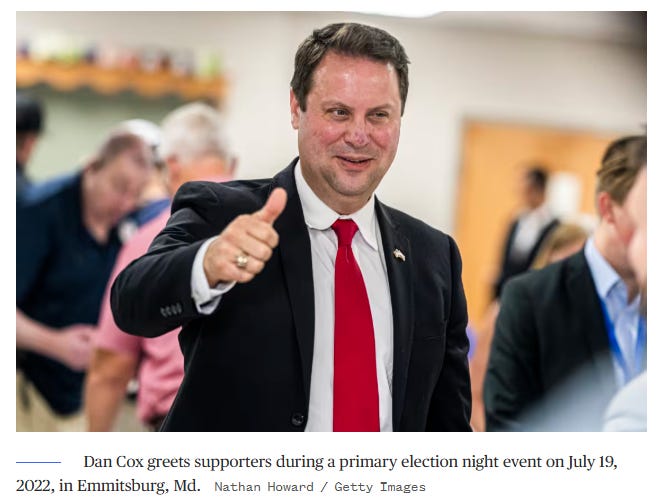
Dan Cox is pushing a new message with the urgency of a man who knows he needs a breakout moment. His latest post — blasted across social media with the all‑caps “BREAKING” flourish — declares that Wes Moore’s approval is “dropping like a rock” while Cox’s own campaign is “surging to win” with “over 2 million social media views.”
Then comes the heart of his argument:
> “Wes Moore won with 1,293,944 votes.
> With 80% Republican turnout, 50% of unaffiliated voters, and just 20% of Democrats done paying for his mistakes — we will hit 1.8 to 1.9 million.
> That’s 500,000 more than he ever got.
> 2026 is not 2022. The votes are there. I’m going to go get them.”
It’s a confident pitch. It’s also a turnout model that requires a suspension of Maryland political gravity.
Let’s take this apart piece by piece.
Moore’s Approval: Yes, It’s Down — But That’s Not a Ballot Test
A new UMBC Institute of Politics poll puts Moore’s approval at 48%, with 42% disapproval. That’s a real decline from his early‑term numbers in the mid‑50s and low‑60s.
Cox isn’t wrong to point to that. Governors don’t like to see themselves under 50%.
But approval ratings measure mood, not votes. They don’t tell you how independents will break, how Democrats will behave in November, or whether a challenger is gaining traction. They’re a snapshot, not a forecast.
The 80% Republican Turnout Claim
This is the first pillar of Cox’s math, and it’s the one that collapses the fastest.
Maryland Republicans have never hit 80% turnout in a gubernatorial year. Not in Hogan’s best year. Not in Ehrlich’s. Not in any modern cycle. GOP turnout typically sits in the 55–65% range.
To get to 80%, you’d need a political climate so electrifying that it would show up in every poll, every donor report, every county meeting. There’s no evidence of that.
50% of Unaffiliated Voters
This is the second pillar.
Maryland independents are not a monolith, but they have been remarkably consistent in one respect: they do not break for MAGA‑aligned candidates in statewide races. This is why Cox lost by 32 points in 2022, even as some down‑ballot Republicans did fine.
Nothing in the UMBC poll suggests a sudden reversal.
20% of Democrats Defecting
This is the third pillar — and the most improbable.
Even in bad years for Democrats, their base does not fracture at 80/20. A governor with a 48% approval rating is not presiding over a mass exodus. Discontent is not the same as defection.
If 20% of Democrats were ready to vote Republican, every pollster in the state would be screaming it from the rooftops.
The 1.8–1.9 Million Vote Projection
This is where the whole structure becomes fantasy.
Moore won with 1.29 million votes.
Cox says he will get 1.8–1.9 million — half a million more than Moore ever received.
To get there, you would need:
- record‑shattering GOP turnout
- a historic collapse in Democratic turnout
- independents flipping in a way they never have
- a political environment that looks nothing like the one we’re actually in
The UMBC poll does not show any of this. It shows a governor with softening numbers — not a state preparing to flip red.
The “2 Million Social Media Views”
Campaigns love big digital numbers because they sound impressive. But views are not votes. They’re not persuasion. They’re not turnout.
If social media views translated into electoral performance, half the state would be governed by TikTok influencers.
So What’s Really Going On?
Cox is taking one true data point — Moore’s approval dip — and building an entire turnout universe around it. It’s a motivational message to his base, not an analytical one.
There’s nothing wrong with optimism. Every campaign needs it. But Maryland voters deserve clarity, not numerology.
The votes may be “there” in the abstract sense that anything is possible in politics. But the math Cox is offering isn’t a roadmap. It’s a wish list.
And Maryland has seen enough elections to know the difference.
If you want, I can also do a shorter, punchier version for social media, or a more clipped Aggressive Article Style version for when you want to sharpen the edges.
“If you want, I can also do a shorter, punchier version for social media, or a more clipped Aggressive Article Style version for when you want to sharpen the edges.”
Enjoy your insights, but put in a little more effort to make sure it’s not so obvious you use chatgpt as a writing aide.