

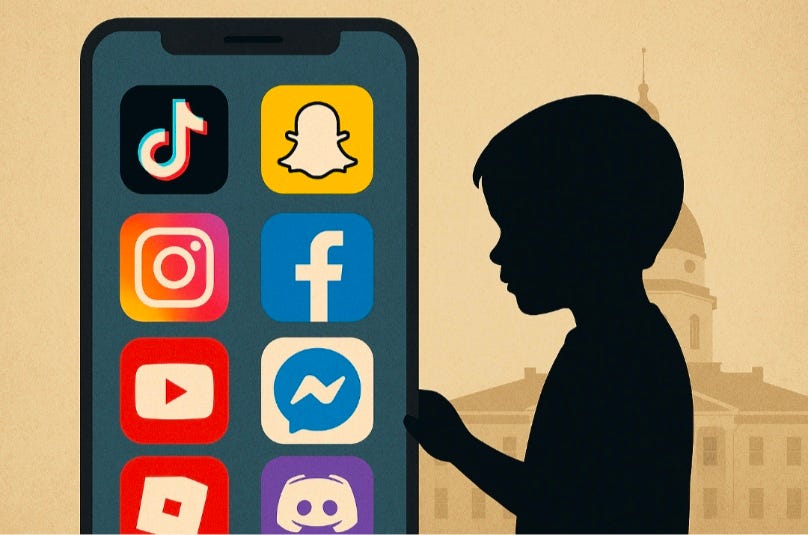
Maryland Is Already Moving to Protect Kids Online. Now Congress Needs to Catch Up.
For years, parents have been told that the digital world is simply too big, too fast, and too unregulated for anyone to meaningfully protect children from the worst parts of it. The platforms say they’re doing their best. The app stores say they’re just storefronts. And families are left to navigate an ecosystem designed without them in mind.
Maryland has stopped accepting that answer.
This session, the General Assembly introduced HB1179 — a bill that finally acknowledges the obvious: the only universal gatekeepers in the digital world are the app stores themselves. If a child can download an app with no friction, no verification, and no parental involvement, then every downstream harm becomes inevitable.
HB1179 tackles that head‑on. It requires age verification at the app‑store level, parental consent for minors, and real enforcement through the Maryland Consumer Protection Act. It’s a serious attempt to close a gap that Silicon Valley has been content to leave wide open.
But Maryland can’t do this alone. And that’s where Congress comes in.
The Federal Bill That Could Set a National Standard
The App Store Accountability Act — introduced by Rep. John James and Sen. Mike Lee — mirrors much of what Maryland is already trying to do. It would require:
- Age verification when users create app‑store accounts
- Parental consent for downloads and in‑app purchases by minors
- Alerts to parents when teens attempt to download restricted apps
These are not radical ideas. They are the bare minimum of what a functioning digital marketplace should provide.
But without a federal baseline, Maryland families are left with a patchwork. One state can enforce its own rules, but the platforms operate nationally. A child in Baltimore should not have weaker protections than a child in Boise simply because Congress hasn’t acted.
And that brings us to the two Maryland lawmakers who now sit at the center of this debate.
Why Maryland’s Delegation Matters Right Now
Sen. Angela Alsobrooks
Alsobrooks sits on Senate committees that increasingly deal with digital‑commerce, consumer protection, and platform accountability. These committees are where the bill will be shaped, amended, and either strengthened or quietly sidelined. Staffers watch for signals from home — especially when those signals come from Maryland institutions, parents, and civic voices.
Rep. Jamie Raskin
Raskin’s committee assignments give him influence over federalism questions and consumer‑protection frameworks. He understands the constitutional tension between state authority and national standards better than almost anyone in Congress. If the bill is going to move, it will need champions who can articulate why a national floor is not only permissible but necessary.
Neither of them has taken a public leadership role on this bill yet. That’s not criticism — it’s simply where the process stands. But this is the moment when committee members decide whether a bill is worth investing political capital in.
Maryland voices can help shape that decision.
The Real Issue: Platforms Externalize Risk, Families Absorb the Cost
This isn’t just about one bill. It’s part of a larger pattern that Maryland has been confronting for years:
- TikTok’s algorithmic targeting of 13–25‑year‑olds
- App stores allowing minors to access adult‑rated content with no friction
- Digital platforms shifting every risk downstream to families, schools, and state budgets
Maryland has repeatedly found itself filling gaps left by federal inaction. HB1179 is the latest example. But the state shouldn’t have to fight this battle alone.
A national standard would give Maryland families what they deserve: a baseline of protection that doesn’t depend on ZIP code or statehouse bandwidth.
What Maryland Needs From Congress
Maryland has already shown its hand. The General Assembly is moving. The Attorney General’s Consumer Protection Division is preparing for enforcement. Parents are demanding clarity and accountability.
Now Congress needs to match that urgency.
Alsobrooks and Raskin are uniquely positioned to guide this bill through the committee stage — the part of the process where most legislation lives or dies quietly. Their leadership could ensure that the final bill reflects the realities Maryland families face every day.
This isn’t about politics. It’s about whether the digital marketplace will continue to treat children as collateral damage in the pursuit of engagement metrics.
Maryland has taken the first step. It’s time for Congress to take the next one.