


Candidate Quality and Turnout in Five Gubernatorial Cycles
When we look at Maryland’s gubernatorial turnout over the last two decades, the numbers tell a story — but the real story is about candidate quality and voter perception. I’ve watched these races closely, and here’s how I see them.
2006: O’Malley vs. Ehrlich — The High-Water Mark
Martin O’Malley’s first win over incumbent Republican Bob Ehrlich produced the highest turnout of the last two decades. It was the most competitive race: a popular Republican governor against a popular Baltimore mayor. Two evenly matched candidates made this contest feel like the most important race in years, and voters responded with the biggest turnout.
2010: O’Malley’s Second Term
Turnout stayed fairly strong, though lower than 2006. O’Malley’s reelection against Ehrlich lacked the same drama, but voters still remembered the sharp contest four years earlier.


2014: Hogan vs. Anthony Brown — Sleepwalking to Defeat
Larry Hogan’s first victory came in a low-turnout year. Anthony Brown, then lieutenant governor, simply failed to animate the electorate. He managed to put the majority of people in Maryland to sleep.
His campaign leaned on gun control and abortion, even though Maryland already had some of the strongest gun laws in the country and abortion was firmly legal. The joke during that campaign was:
> “The only way you could make abortion law much more liberal would be to allow the mother to abort the child up until the he or she started first grade.”
Brown didn’t give voters anything they cared about, and turnout collapsed. Hogan slipped through.
2018: Hogan vs. Ben Jealous — The Socialist Perception
Hogan’s reelection drew a strong turnout, but many voters weren’t voting for Hogan so much as against Jealous. He was widely perceived as a lunatic socialist, and that perception drove independents and conservative Democrats to stick with Hogan.
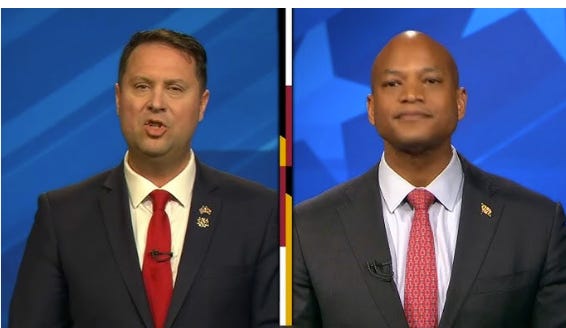
2022: Moore vs. Dan Cox — A Campaign Lost in Translation
Wes Moore’s victory was practically assured because Dan Cox was, bluntly, a dunderhead who didn’t know how to campaign.
Cox’s problem wasn’t just his hard-right primary strategy — it was his refusal to pivot afterward. He kept hammering MAGA issues that didn’t translate to independents or conservative Democrats. Instead of focusing on crime, inflation, or bread-and-butter concerns, he leaned into oddball themes like “transsexual indoctrination kindergarten through third grade.”
Most voters thought that was a joke. Outside of his MAGA base, the message was ridiculous and alienating. Moore’s win was as good as decided the moment Cox refused to broaden his appeal.
Conclusion
Maryland’s gubernatorial turnout cycles show a clear pattern:
- Competitive races (2006) drive the highest turnout.
- Uninspired candidates (2014) depress participation.
- Perceived extremism (2018, 2022) mobilizes voters against rather than for.
Candidate quality matters as much as party alignment. In Maryland, turnout is not just about the calendar — it’s about whether voters believe the race is worth their time.
The "Quality" starts with the primaries. Voters sometimes seem to be smarter in the General Election, fixing what the primaries got wrong.