

Author’s Note
A quick note before we dive in: It is a rare occasion when Len Foxwell and I find ourselves on opposite sides of a policy debate. Usually, he’s the sounding board who helps me sharpen my own conclusions. On the question of expanding alcohol sales to Maryland supermarkets, however, our priorities diverge. Len rightly highlights the real-world impact of bad-neighbor retailers on vulnerable communities; I’m looking at how smart licensing reform could incentivize grocers to invest in underserved food deserts. We both agree the status quo needs work—and we both agree that while broad supermarket expansion in Maryland is ultimately inevitable, it is by no means imminent. We simply differ on how the General Assembly should bridge the gap.
The Illusion of the “Grocery Store Year”: Why Maryland’s Alcohol Fortress Is Changing, Not Collapsing
By Barry O’Connell
Every legislative cycle, mainstream news outlets run the predictable story: This is finally the year beer and wine enter Maryland grocery stores.
To the casual observer, the argument seems logical. The old guard that built and fortified Maryland’s strict three-tier alcohol distribution network for half a century has faded. The historic “Mike and Mike” era—defined by the ironclad house dominance of Speaker Michael E. Busch and the long-serving Senate President Thomas V. Mike Miller Jr.—is gone. Key lieutenants who maintained the legislative firewall, including former House Economic Matters Chair Dereck Davis (now State Treasurer) and his successor C.T. Wilson, have transitioned out of those legislative roles.
With new legislative leadership taking root, media pundits assume the defensive perimeter around independent package stores has dissolved. But those who measure power in State House committee rooms know better. The fortress hasn’t fallen; its command structure has simply evolved.
The Human Defense: Immigrant Ownership and the Realities of Main Street
The traditional argument for deregulation frames independent liquor license holders as an outdated monopoly resisting consumer convenience. That narrative ignores the modern demographic reality of Maryland’s retail alcohol industry.
Across the state—and particularly in Prince George’s and Montgomery counties—the independent package store ecosystem is heavily anchored by immigrant small-business owners. For these entrepreneurs, a county liquor license represents a massive capital investment, often secured through life savings, personal debt, and multi-generational family labor.
This dynamic hits home directly within top legislative leadership. Speaker Joseline Peña-Melnyk (JPM), who immigrated to the United States from the Dominican Republic as a child, brings a sharp perspective on working-class immigrant enterprise. While local bodies like the Prince George’s County Council push punitive municipal fees on small retailers, JPM’s caucus views these small-business owners through a lens of economic protection rather than hostility.
Further insulating the retail sector is Delegate Kriselda Valderrama, Chair of the House Economic Matters Committee. Valderrama, a powerhouse Prince George’s legislator and daughter of former Delegate David Valderrama (the first Filipino-American elected to a mainland state legislature), represents both the new face of legislative authority and a bridge to institutional memory. While her elevation reflects Maryland’s shifting leadership demographics, her deep roots in county political history mean she understands the human cost of sudden market disruption on local license holders.
When multi-state grocery chains lobby for deregulation, they aren’t just taking on distribution lobbyists like Bruce Bereano or traditional Annapolis firms; they are asking an immigrant-led House leadership team to dismantle the livelihoods of immigrant family enterprises in favor of out-of-state corporate cartels.
The Problem of the “Bad Neighbor” vs. Decent Livelihoods
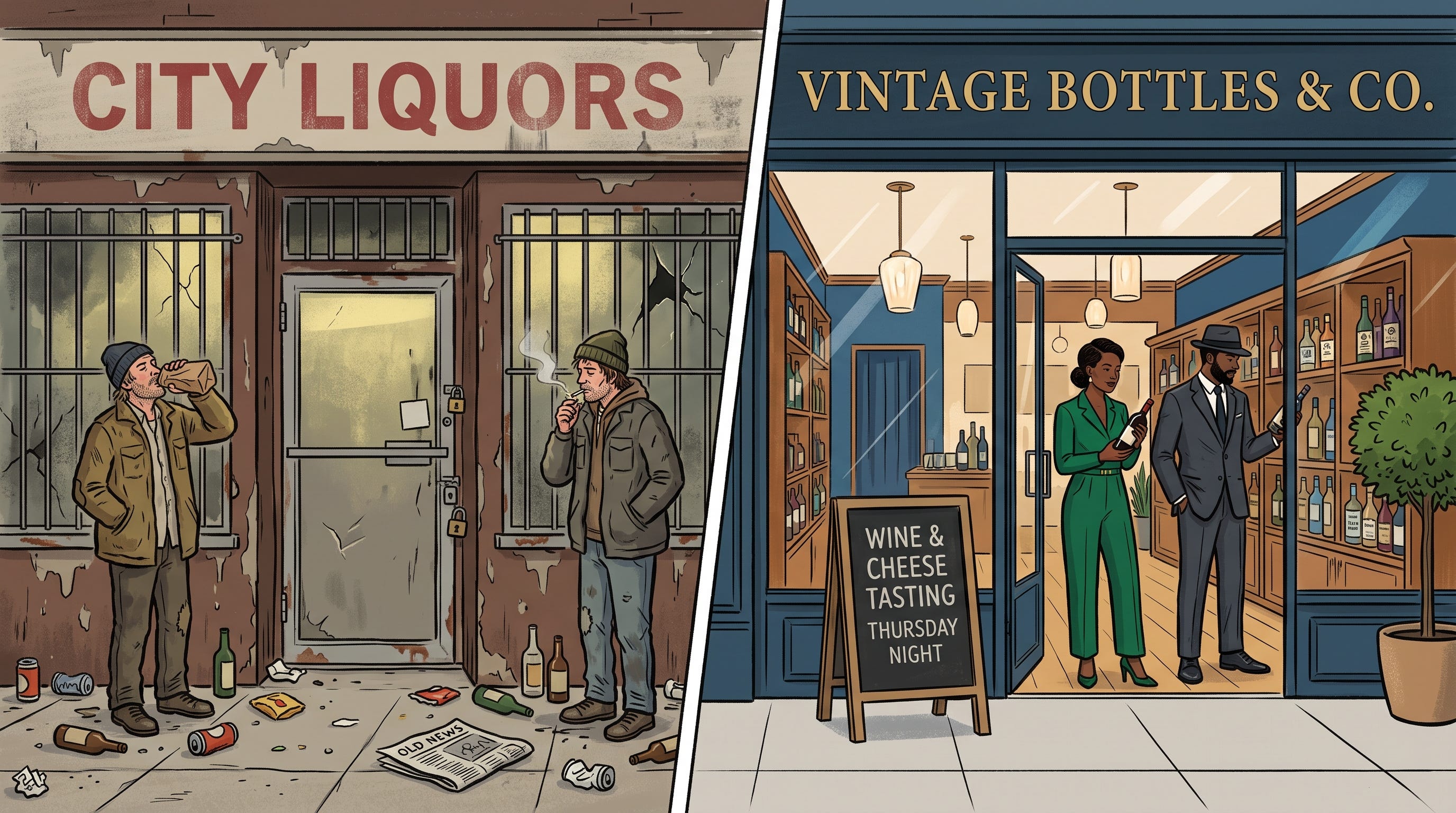
This is where my conversations with Len Foxwell get particularly interesting. Len looks at the lower end of the retail package store market—especially in places like Prince George’s County—and sees retailers that have become genuine community blights.
These are the locations operating behind bulletproof glass and wire counters, willing to skirt the law by selling single loose cigarettes or breaking apart six-packs to sell individual beers. That operational model caters to a low-income customer base in a way that many neighborhood advocates feel breeds vagrancy, public intoxication, and local crime. Len argues that if the state ever opens the door to supermarket sales, it must come with strict conditions—such as mandatory dedicated Maryland craft beer and wine sections—and a deliberate effort by Senate and House leadership to phase out or eliminate these bad-actor locations.
I don’t dismiss Len’s concerns; I’ve seen those same storefront blights. But I also look at the human equation. Even in a store that struggles with community relations, the family running it is often using those margins to pay a mortgage, buy health insurance, and send their kids to college. Before state policy pulls the plug on otherwise decent, hardworking Marylanders who built a business under the rules they were given, we need to approach reform with a far higher degree of sensitivity.
The Trone Factor: How Campaign Fallout Poisoned the Big-Box Argument
If the small-business defense provides the moral barrier to grocery store sales, the political fallout surrounding Total Wine & More founder David Trone provides the personal one.
For years, proponents of expanding retail alcohol sales pointed to Total Wine’s superstore model as the future of consumer choice. However, Trone’s political maneuvers over recent election cycles created deep, lasting friction across the Maryland Democratic establishment. His hard-fought primary battles against party-backed candidates—most notably U.S. Senator Angela Alsobrooks—strained relationships with state and federal leadership.
More damaging within Annapolis political circles was the revelation regarding dark-money campaign expenditures during the 2022 Democratic primary for Attorney General, when funds were routed to target former Maryland First Lady Katie Curran O’Malley.
As a result, any legislative push that drops the multi-store restriction without strict statutory guardrails is instantly linked to Trone. In a General Assembly where personal relationships and political loyalty remain currency, handing a major policy victory to a billionaire political rival who spent millions attempting to defeat party leadership is an absolute non-starter.
The Innovation Opportunity: Licensing as an Engine for Food Deserts
So where does that leave us? If a blanket free-market blowout isn’t happening, can we use alcohol licensing for meaningful social engineering?
I believe the answer lies in leveraging the fundamental economics of retail food and beverage:
Groceries are notoriously low-margin, high-volume operations.
Beer and wine are high-margin, predictable-yield items.
In many urban and rural Maryland neighborhoods—areas classified as food deserts—it is economically unfeasible for a national or regional grocery chain (whether Giant, Safeway, ShopRite, or Kroger) to open a full-service supermarket. The low-margin grocery sales alone cannot justify the real estate and operational risk, leaving those communities stranded with dollar stores and corner convenience marts.
What if the General Assembly created a brand-new, highly targeted class of license?
Instead of opening the floodgates statewide, Maryland could issue specialized beer and wine licenses exclusively to full-service grocers willing to build and operate in designated food deserts. To qualify, a store couldn’t just throw a single refrigerated cooler of milk and cheese next to a wall of beer. It would be required by law to devote at least 50% to 60% of its floor space to a complete range of fresh food: fresh produce, raw meats, dairy, eggs, and dry staples.
By allowing a grocer to pair high-markup alcohol sales with low-markup essential foods under one roof, the state instantly alters the math for developers. Locations that were previously non-viable suddenly become sustainable commercial anchors.
Finding the Middle Ground in Annapolis
Len Foxwell and I agree that the status quo is far from ideal, and we agree that change won’t happen overnight. But rather than waiting for an all-or-nothing political showdown that pits big-box grocers against neighborhood package stores, Maryland has an opportunity to lead with smart, incremental reform.
By maintaining traditional package store protections in established markets while using targeted beer-and-wine licenses to attract full-service grocers to underserved communities, the General Assembly can protect immigrant small-business equity, eliminate food deserts, and give Marylanders the modern retail choices they deserve.
The fortress doesn’t need to be demolished—it just needs to open the right doors.
The Maryland Wire is often published without a paywall to ensure open access to vital state policy debates impacting our communities.