


🕊️ Fragmented Faith, Fractured Map: How Baltimore County’s Jewish Vote Could Reshape the Executive Race
By Barry O’Connell
October 2025
The Jewish community of Baltimore County—long a cultural cornerstone of Pikesville and northwest Baltimore—is now politically fragmented. That fragmentation may prove decisive in the upcoming County Executive race, where Councilman Izzy Patoka is courting a narrow but fervent slice of the electorate: Orthodox and conservative Jewish voters, many of whom are registered Republicans and unlikely to vote in the Democratic primary.
📊 Demographics and Voting Behavior
According to the 2020 Jewish Community Study conducted by Brandeis University, approximately 6% of Baltimore County residents identify as Jewish, with the largest concentrations in Pikesville and Owings Mills. Of that 6%, roughly one-third identify as Orthodox or conservative, meaning only about 2% of the county’s total population falls into this more traditionalist bloc.
This bloc tends to vote Republican and prioritize issues like zoning, school choice, and religious accommodations. Their influence is amplified by geographic concentration and high turnout, but their primary participation is limited—most are registered outside the Democratic Party.
Meanwhile, the remaining two-thirds of Jewish voters—largely Reform and liberal—tend to support civil rights, public services, and Democratic candidates. Many are quietly leaning toward Julian Jones, the only Black candidate in the race, who has avoided identity politics and focused on governance.
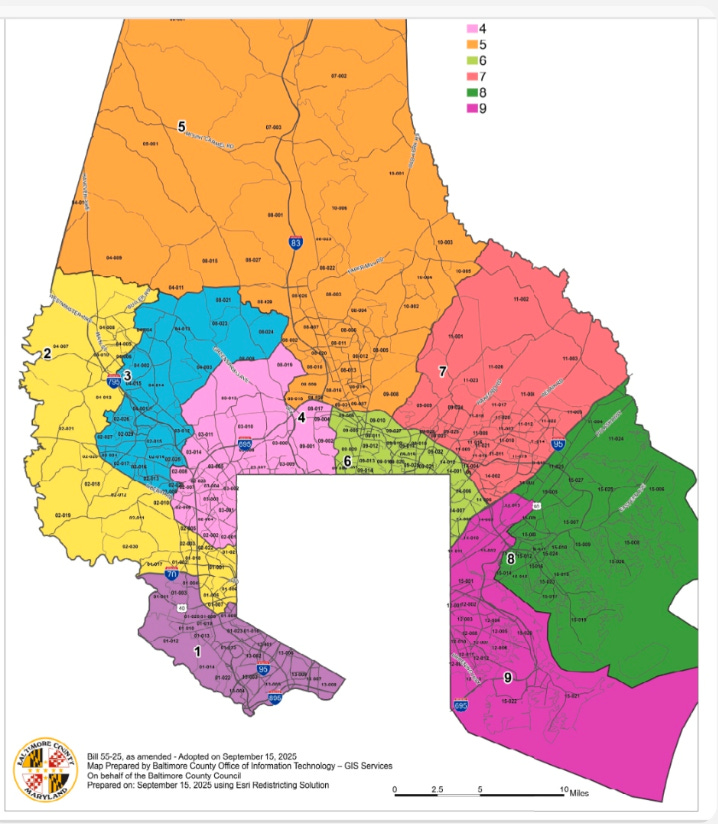
🗺️ The Map That Broke the Coalition
The redistricting battle has become the defining issue of the race. Patoka, alongside Council Chair Mike Ertel, introduced a map that splits historically Black communities like Woodlawn and replaces a long-standing Black-majority district with a patchwork of “majority-minority” zones.
Critics argue this map dilutes Black representation and sets the stage for demographic engineering. The most controversial move? Patoka’s support for Ruben Amaya—a Hispanic candidate with ties to the Young Democrats sexual assault scandal—as a potential successor in Julian Jones’s district.
⚖️ Coalition Math and Electoral Risk
In a four-way Democratic primary featuring three white candidates and one Black candidate, the Black vote—typically 40–44% of the Democratic primary electorate—becomes decisive. If Patoka alienates even a portion of that bloc, he risks being frozen out.
To win, Patoka would need to:
- Lock up the Orthodox and conservative Jewish vote (≈2%)
- Pull significant support from Republican crossovers (limited due to registration)
- Cut deeply into the bases of Nick Stewart and Patrick Young
But Stewart is running hard, and Young—though laid-back—is still drawing support from progressive and Black voters. That leaves Patoka with a shrinking path to 51%.
🧩 The Cultural Undercurrent
Some community tensions are quietly shaping policy debates. For example, opposition to public swimming pools in Pikesville has surfaced among Orthodox leaders, citing concerns about modesty and racial mixing. While rarely stated publicly, these views influence zoning and recreation decisions.
This puts Patoka in a precarious position: by aligning with Orthodox and conservative interests, he risks alienating liberal Jewish voters and Black Democrats—two groups historically aligned on civil rights and inclusion.

🌟 A New Generation: Karson Kamenetz Steps Forward
Amid this fragmentation, a new name is rising: Karson Kamenetz, son of the late County Executive Kevin Kamenetz, who served Baltimore County with distinction until his untimely death while running for governor in 2018.
Karson, now 23, is running for County Council in the Second District—the very seat his father held for 16 years before becoming County Executive. Despite his youth, Karson has already served on the Baltimore County Democratic State Central Committee and carries the ethos of public service embedded in his family legacy. Any people in Baltimore County and not just in the Jewish Community say that the next Jewish County Executive is going to be Karson.
> “That leadership is something I know how to do because I’ve been surrounded by it my whole life,” Karson told WYPR. “The ethos of my family was you are a servant.”
I believe Karson Kamenetz is an excellent candidate—principled, grounded, and ready to serve. His candidacy offers a bridge between tradition and progress, and his presence in the race brings hope to those seeking unity across Baltimore County’s fractured coalitions.
🧭 Conclusion: A Fractured Coalition, A Fractured Future?
Baltimore County’s Jewish community is not monolithic. It spans the political spectrum, from Orthodox Republicans to Reform Democrats. Patoka’s strategy—anchored in a narrow slice of that spectrum—may win him fervent support, but it could cost him the broader coalition needed to govern.
In the end, the map may tell the story. And voters will decide whether it’s a blueprint for inclusion—or a warning sign of fragmentation.