

Anchor Medicine: How State Regulatory Policy Is Turning Urban Retail Strip Malls into Hospital Outposts
By Barry O'Connell The Maryland Wire
If you drive down Route 40 into West Baltimore, past the weathered facades and long-faded commercial signs of the Edmondson Village Shopping Center, you can spot the quiet shift currently underway in urban retail.
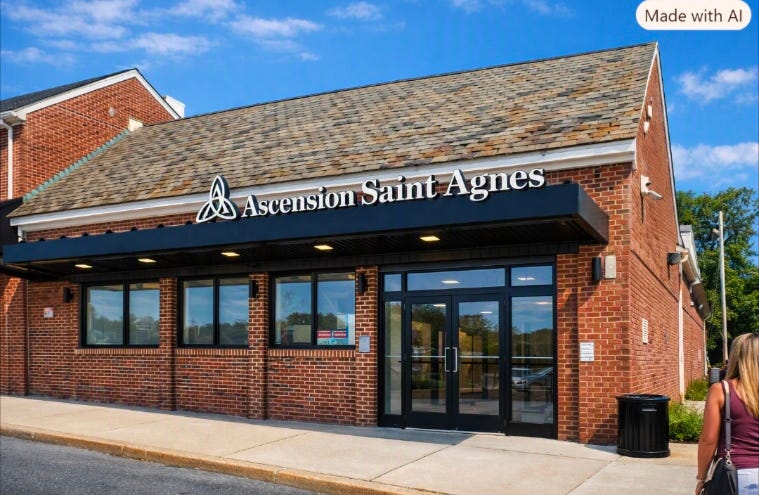
Last week, Ascension Saint Agnes leadership took a site visit to their brand-new primary care clinic preparing to open its doors inside the center. Highlighting the system's strategic vision for West Baltimore, Olivia Farrow, Esq., Vice President of External Affairs at Ascension Saint Agnes, noted that bringing primary care into the neighborhood goes beyond routine clinical visits—it directly addresses long-term health outcomes and systemic spending.
"When people have reliable access to primary care, they're far less likely to end up in the Emergency Department for issues that could have been prevented or managed earlier," Farrow stated. "That means better outcomes for patients and lower health care costs for everyone."
On its face, the initiative is a heartening story about delivering preventive health care, regular checkups, and chronic condition management directly to a neighborhood that severely lacks them. But if you follow the flow of state health care dollars and state land-use policy in Maryland, there is a far bigger story playing out behind that brand-new drywall.
What is happening at Edmondson Village is not merely an act of community goodwill. It is a real-time reflection of how Maryland’s state regulatory environment—specifically our unique hospital global budget caps—is forcing major health systems to rethink their business models, vacate high-cost emergency rooms, and transform into commercial real estate anchor tenants.
The Capital Pivot: From Mobile Vans to 5,000 Square Feet
For months, Ascension Saint Agnes tested the waters at Edmondson Village the hard way: parking a mobile health clinic van in the shopping center lot on Mondays. It served as a triage station, bridging care gaps in a zip code where primary care physicians remain critically scarce compared to surrounding suburban jurisdictions.
Moving from a weekly van to a permanent, 5,000-square-foot brick-and-mortar facility capacity-planned for over 9,000 annual visits marks a major capital pivot.
To picture what 5,000 square feet actually looks like in a classic strip mall, think back to the pre-internet heyday of suburban shopping centers. It isn't the sprawling, 100,000-square-foot footprint of an old Kmart or a modern superstore. Instead, 5,000 square feet is roughly twice the size of a classic RadioShack—or the exact footprint of a mid-century corner A&P grocery, an old Eckerd Drugstore, or a neighborhood Western Auto.
Where working families once walked in to buy television tubes, pick up a prescription, or buy a lawnmower spark plug, patients will soon be walking in for blood pressure checks and diabetes management.
In traditional commercial real estate, anchor tenants were retailers designed to generate foot traffic for surrounding local shops. Today, across urban corridors in Baltimore and Prince George’s County, forward-looking medical systems are rapidly becoming the new "medtail" anchors, moving into those familiar mid-sized storefronts.
For commercial property owners struggling with retail vacancy, a major hospital network offers something traditional retail rarely can anymore: long-term, high-credit leases backed by institutional capital. But for the health systems themselves, occupying 5,000 square feet in a strip mall is an operational necessity driven directly by state policy.
The Policy Driver: The HSCRC and the Push to Bend the Curve
To understand why a health system wants to manage a clinic next to a retail shop, you have to look at the Health Services Cost Review Commission (HSCRC) and Maryland’s Total Cost of Care Model.
Unlike every other state in the nation, Maryland operates under a unique federal waiver that sets global budget revenues for hospitals. Under this framework, hospitals do not make more money by filling up beds or packing emergency rooms. In fact, under the state's Episode Quality Improvement-Primary Care (EQIP-PC) initiatives and value-based care mandates, treating a patient in an Emergency Department for an unmanaged, preventable condition—like uncontrolled hypertension or diabetes—is a financial penalty against the system's margin.
Farrow’s emphasis on diverting non-emergent care away from hospital wards aligns directly with these state regulatory metrics. In West Baltimore medical deserts, the Emergency Department has historically acted as the primary care physician of last resort. It is the most expensive, least efficient way to deliver care, straining hospital capacity and driving up system-wide costs.
By decentralizing operations and establishing primary care outposts in high-Medicaid, low-income corridors, health systems are executing a deliberate financial and operational strategy:
Divert non-emergent foot traffic away from acute care facilities before it hits the ER doors.
Capture patient panels early through routine screenings to meet state quality metrics.
Stabilize operating margins under global budget caps by keeping expensive hospital admissions low.
The Real-World Test for Main Street
For the residents surrounding Edmondson Village, accessible primary care is long overdue. If a neighborhood clinic keeps a working parent out of the ER and catches a chronic illness before it becomes debilitating, the human value is undeniable.
The policy question for Maryland lawmakers and local leaders is whether this regulatory model can deliver on its double promise: revitalizing historic commercial corridors while genuinely bending the cost curve on urban health outcomes.
Replacing empty storefronts with clinical exam rooms stabilizes retail real estate, but it also reflects a broader reality—our public policy is increasingly relying on private health systems to act as urban planners, commercial anchors, and social safety nets all at once.
As Ascension Saint Agnes cuts the ribbon in Edmondson Village, The Maryland Wire will be tracking the data behind the PR: watching whether these decentralized outposts meaningfully lower surrounding ER utilization, how state policy continues to subsidize hospital footprint expansions, and what this shift means for the future of urban commercial land use.