

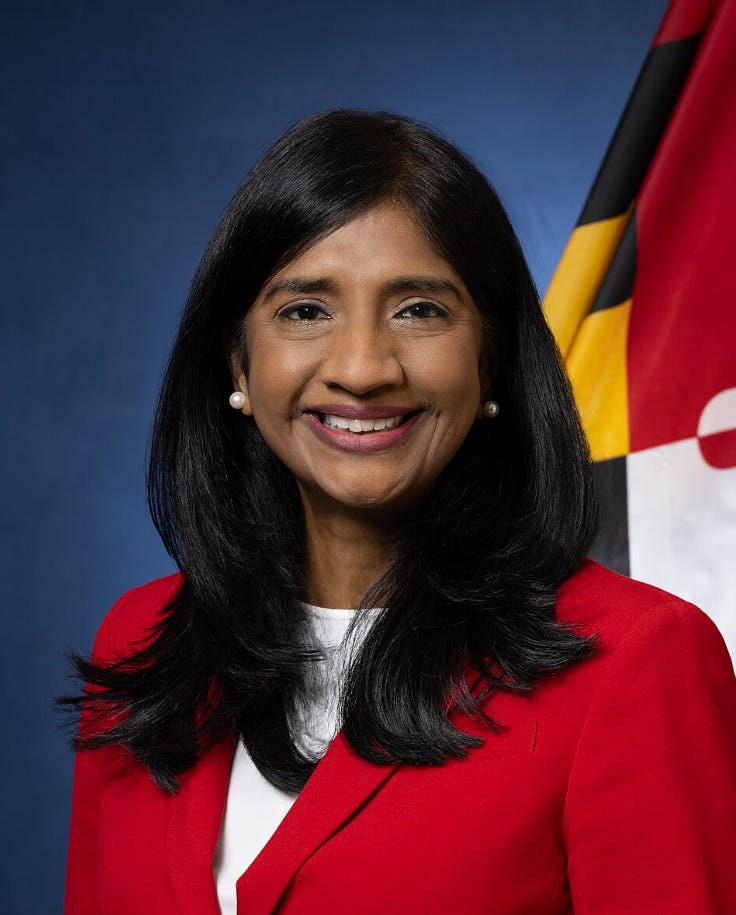
The Engineer at the Desk: Lieutenant Governor Aruna Miller’s Executive Reality
When Aruna Miller took the oath of office as Maryland’s 10th Lieutenant Governor, she brought something to the executive branch that is historically rare in Annapolis politics: 25 years of experience as a civil engineer.
For a quarter-century in Montgomery County government, Miller’s job wasn't to manage political narratives; it was to ensure systems worked. Infrastructure doesn't care about caucus politics—it either carries the load or it collapses. That technical mindset shaped her eight years representing District 15 in the House of Delegates, but legislative life in Annapolis requires a different set of skills, often forcing policy decisions into the rigid constraints of leadership priorities.
Since stepping into the executive suite alongside Governor Wes Moore, Miller has operated with a level of independence and administrative authority that defines her executive tenure:
Workplace & Roadway Safety: Drawing directly on her civil engineering background, Miller chaired the state’s Work Zone Safety Work Group following highway casualties in the state. Her hands-on leadership directly produced the Maryland Road Worker Protection Act of 2024, modernizing speed enforcement and safety protocols in active transit corridors.
Administrative Heavy Lifting: As a core operational partner in the administration, Miller regularly presides over crucial state business, including sessions of the Board of Public Works (BPW) when required, ensuring state procurement and capital projects move without administrative drift.
Building Civic Infrastructure: Beyond hard engineering, she established Maryland’s first-ever statewide Interfaith Council, creating a structured pipeline for faith-based communities to collaborate directly with state agencies on social services and local relief.
Miller has proven that when you hand a trained engineer the keys to an executive portfolio, she doesn't just hold press conferences—she optimizes the machinery.
