

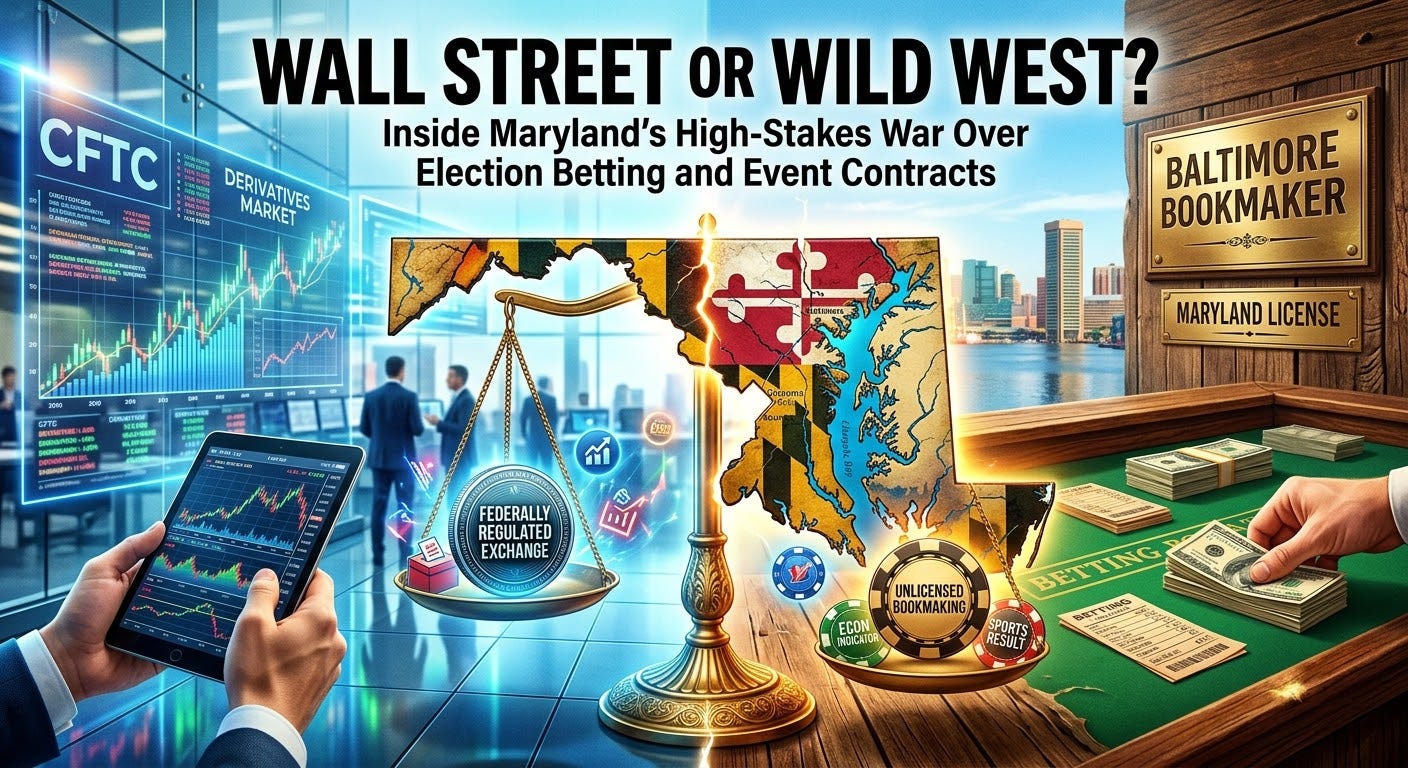
Wall Street or Wild West? Inside Maryland’s High-Stakes War Over Election Betting and Event Contracts
A structural conflict at the intersection of state tax policy, regulatory sovereignty, and financial innovation is quietly coming to a head in Annapolis and Baltimore. At its core is a deceptively simple question with multi-billion-dollar consequences:
Is a trade on a political outcome, economic metric, or sports result on a federally designated exchange a legal financial derivative, or is it unregulated bookmaking operating outside state tax boundaries?
As the City of Baltimore files consumer protection suits against platforms like Kalshi and Polymarket, and as the Maryland Lottery and Gaming Control Agency (MLGCA) defends its statutory authority before the U.S. Fourth Circuit Court of Appeals, the state has become the ground zero for national gaming policy.
For commercial casino operators, licensed sportsbooks, and state budget directors, the outcome will dictate whether a vast pool of wagering capital remains subject to state oversight and local taxation—or flows tax-free into federally sheltered financial exchanges.
