

Executive Overview
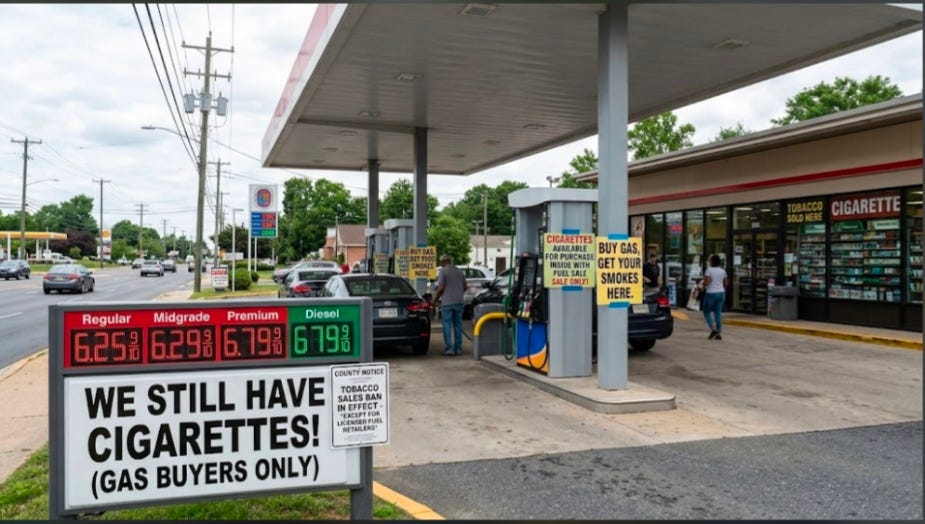
Local regulatory overreach often collides directly with state statutory limits. A prime example is Prince George’s County Council Bill CB-083-2026. Passed by the Council on October 27, 2026, the bill restricts the retail sale of tobacco and tobacco-related products strictly to convenience stores that operate fuel-service gas stations, effectively banning sales at standalone convenience stores and retail shops.
While framed by proponents as a public health measure targeting standalone “smoke shops”, CB-083-2026 presents serious legal vulnerabilities under Maryland municipal law, potential Equal Protection violations, and adverse economic consequences for local small business owners.
1. Implied Preemption: Defying Maryland Supreme Court Precedent
The primary legal challenge to CB-083-2026 rests on the doctrine of implied preemption by occupation. Under Maryland constitutional law, local jurisdictions (counties and municipalities) cannot legislate within a domain where the General Assembly has established a comprehensive, statewide statutory framework. When the state “occupies the field,” local ordinances regulating the same subject matter are preempted and rendered void.
The Maryland Supreme Court (formerly the Court of Appeals) has twice established that the regulation, licensing, packaging, and sale of tobacco products are field-preempted by state law:
Allied Vending, Inc. v. City of Bowie, 332 Md. 279, 631 A.2d 77 (1993): The Court struck down local municipal ordinances attempting to ban or restrict cigarette vending machines, holding that Maryland’s statewide licensing scheme occupied the entire field of tobacco vending and retail access.
Altadis U.S.A., Inc. v. Prince George’s County, 431 Md. 307 (2013): Striking down two Prince George’s County ordinances regulating single-cigar sales and packaging, the Court held explicitly that state law occupies the field of regulating the packaging and sale of tobacco products.
Because CB-083-2026 directly regulates which retail establishments may sell tobacco products within the county, it appears to infringe upon state preemption principles established in Allied Vending and Altadis U.S.A.
                       STATE PREEMPTION ARCHITECTURE

    +------------------------------------------------------------------+
    |                    Maryland General Assembly                      |
    |      Comprehensive Statewide Tobacco Regulation & Licensing       |
    +------------------------------------------------------------------+
                                     |
             Field Preemption Doctrine (Occupies the Field)
                                     |
               +---------------------+---------------------+
               |                                           |
               v                                           v
     Allied Vending (1993)                       Altadis U.S.A. (2013)
     Municipal Vending Bans                      County Cigar Packaging Bans
     --> INVALIDATED                             --> INVALIDATED
                                     |
                                     v
                       Prince George's County Council
                            CB-083-2026 Ordinance
                            --> HIGHLY VULNERABLE
2. Constitutional Vulnerability: Equal Protection & Arbitrary Classifications
Beyond preemption, the specific amendment added to CB-083-2026 creates exposure under the Equal Protection Clause of the 14th Amendment and the Maryland Declaration of Rights.
The Fuel-Service Exemption: The ordinance prohibits retail sales of tobacco products at convenience stores, unless the location also sells gasoline.
The “Arbitrary and Capricious” Standard: Under rational basis review, statutory classifications must bear a rational relationship to a legitimate governmental objective. Treating two otherwise identical convenience stores differently based solely on whether they dispense motor fuel creates an arbitrary distinction.
Lack of Public Health Rationale: There is no established public health evidence indicating that purchasing tobacco at a facility with gasoline pumps poses less risk to minors or public health than purchasing the same product at a standalone convenience store. Distinguishing between classes of convenience stores based on fuel sales exposes the regulation to claims of arbitrary action.
3. Commercial Realities: Revenue Leakage and Economic Impacts
From a business perspective, localized product bans rarely eliminate consumer demand. Instead, they shift commerce across geographic boundaries:
Commercial FactorImpact of CB-083-2026Retail EquityDisadvantaged independent, non-fuel convenience store owners while insulating larger gas station chains.
Border Leakage Consumer spending shifts to neighboring jurisdictions (e.g., Montgomery County, Anne Arundel County, or Washington, D.C.) or fuel-dispensing retailers.
Secondary Sales Impact Standalone convenience stores lose high-margin ancillary sales (beverages, snacks, lottery) alongside primary tobacco revenue.
Litigation Burden Passing regulations that conflict with state judicial precedent places legal costs on local merchants, who must litigate to defend their state retail licenses.
Key Takeaways for Investors and Industry Observers
High Risk of Invalidation: If signed into law, CB-083-2026 faces immediate exposure to temporary restraining orders (TROs) and litigation grounded in binding Supreme Court of Maryland precedent.
Precedental Overreach: Local efforts to bypass statewide licensing schemes create regulatory unpredictability for commercial real estate tenants, franchise operators, and retail licensees.
Veto Likelihood: Executive veto requests centered on structural state preemption and equal protection offer local leadership a legal rationale to decline signing ordinances prone to costly judicial overturn.