

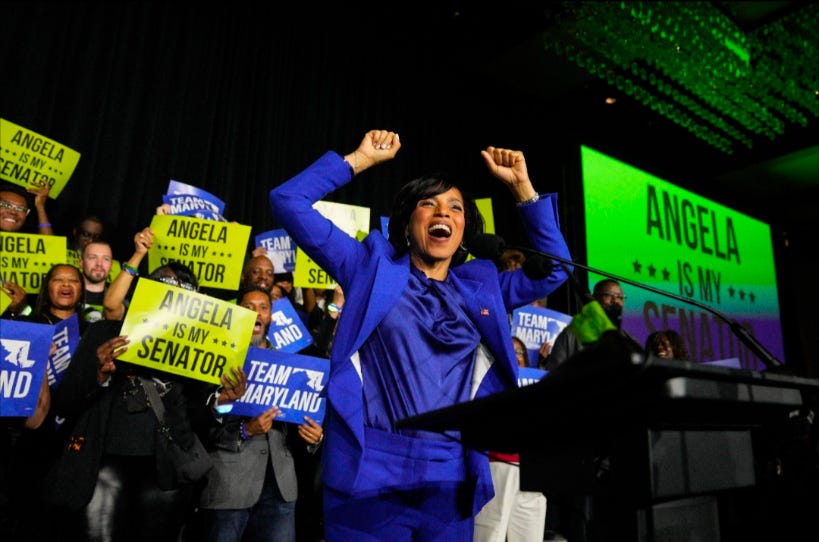
An Open Letter to Senator Alsobrooks: Hold the Line on the CLARITY Act
By Barry O’Connell
The eyes of Maryland—and the nation—are on you, Senator Alsobrooks.
When you and Senator Gallego voted the CLARITY Act out of the Senate Banking Committee, you made it clear that your “yes” was not a blank check. It was a vote for continued negotiation, contingent on a firm, non-negotiable principle: Marylanders do not tolerate a double standard for financial transparency or public corruption. Alongside Senator Gillibrand, you drew a line in the sand, stating that enforceable ethics provisions and robust anti-money laundering (AML) controls are absolute prerequisites for your vote on the Senate floor.
Now, the legislative rubber meets the road. Recent disclosures and deep structural flaws within the current bill have turned your prerequisites into a defining test of legislative oversight.
To protect consumers, safeguard community banking, and preserve the integrity of public service, you must hold that line and vote NO on final passage unless three critical loopholes are permanently sealed.
1. Close the “Superhighway for Corruption”
The Office of Government Ethics recently released President Trump’s annual financial disclosure, revealing an astonishing $1.4 billion in crypto-related income for 2025 alone. This includes over $635 million from$TRUMP meme coin sales and more than $500 million from World Liberty Financial token sales.
Crypto is now the single largest source of the president’s personal income. As former White House ethics counsel Richard Painter rightly noted, this creates an unprecedented, clear conflict of interest. The executive branch is actively rewriting the rules for an asset class in which the commander-in-chief holds an immense personal stake.
Yet, the White House has opposed any ethics language touching these holdings, and an amendment by Maryland’s own Senator Van Hollen to block officials from profiting off crypto policy failed in committee. Without enforceable guardrails, the CLARITY Act opens a “superhighway for corruption,” allowing public officials to trade on non-public information and enabling foreign adversaries to purchase leverage via official-affiliated tokens.
The Mandate: No policymaker should profit from the legislation they write. You have the public justification to insist on strict, enforceable ethics restrictions before this bill hits the floor.
2. End the “Illicit Finance-Friendly” AML Standards
The Bank Policy Institute has flatly warned that the current Senate text is “illicit finance-friendly”. While traditional banks operating in Baltimore and Prince George’s County are bound by rigorous Bank Secrecy Act (BSA) standards, the crypto industry is being offered an online pass. Consumers lost a reported $9.3 billion to crypto financial crime in 2024—a figure that grossly undercounts the true scale of endemic fraud and digital hacks.
As drafted, the CLARITY Act:
Leaves Decentralized Finance (DeFi) platforms and unhosted wallets completely exempt from standard compliance.
Fails to give FinCEN clear authority to regulate and sanction token mixers and tumblers used by bad actors to wash illicit funds.
Creates an obvious workaround for bad actors by exempting offshore custodians.
Applies a light-touch, tiered standard to digital asset brokers rather than uniform banking accountability.
Weak standards invite sanctions evasion, terrorist financing, and human trafficking. The crypto sector must meet the same exact anti-money laundering standards as traditional financial institutions.
3. Fix the “Yield Loophole” to Protect Maryland’s Community Banks
Beyond ethics and crime, the current text poses a structural threat to Main Street Maryland. While stablecoins are ostensibly built as payment instruments, crypto firms are aggressively exploiting a legal loophole—partnering with third-party platforms to pay interest and structural rewards to depositors.
If this “yield loophole” isn’t closed, capital will flee local financial institutions for high-yield crypto platforms. Small community banks—the lifeblood of funding for rural towns and urban neighborhoods alike—will face a projected $110 billion contraction in local lending nationwide.
When community banks lose local liquidity, they must pivot to more expensive funding sources. Those costs get passed directly to Maryland families trying to finance a home and small businesses looking to expand. Furthermore, this deposit flight completely undermines the Community Reinvestment Act (CRA), starving low- and moderate-income households of the reinvestment capital they legally depend on.
Hold the Line, Senator
Senator Alsobrooks, your constituents trusted you to bring rigorous, pragmatic leadership to Washington. The Trump financial disclosure has stripped away any ambiguity or hypothetical debate regarding these risks.
Bipartisan negotiations have failed to yield adequate protections for our local banks and everyday consumers. Stand firm with your principles. Tell the leadership that without comprehensive ethics rules, full BSA/AML coverage for DeFi and mixers, and a closed yield loophole, the CLARITY Act does not deserve your vote.
Great work...good reserch! Pretty sure you heard about Trump's new bank... Think its called World Trust. Just one more place to hide money from the IRS ...ALOT of money. Thanks for your time and efforts in MD.
Thank you very much for speaking out. She is also the cosponsor of another terrible bill, SB 1404, combat organized retail crime, normally an FBI thing i think. But DHS/ICE is the lead. It's supported by many big retail companies, who also have lots of surveillance to share. With ICE renditioning people off the streets and too frequently executing them on the spot, giving DHS MORE responsibilty is tone deaf...to be kind about it. Working on retail crime when the financial crypto grift of Trump and company is destabilizing the country... Her choices are only abetting the demise of our democracy. It's soul crushing that I campaigned for her. She's on banking and on Judiciary which makes her an ongoing threat im very sorry to say..