

By John Barry O’Connell
For Anthony Tilghman, public service has never depended on holding an elected office or having a title.
A longtime community leader, executive director of the youth nonprofit Make Smart Cool, and former City Commissioner for District Heights, Tilghman has spent years working with young people and families throughout Maryland. Most recently, he concluded a competitive campaign for the Maryland General Assembly. But while campaigns have clear beginning and end dates, Tilghman says service does not.
“Service has no title,” Tilghman said. “You do not have to be in office to serve.”
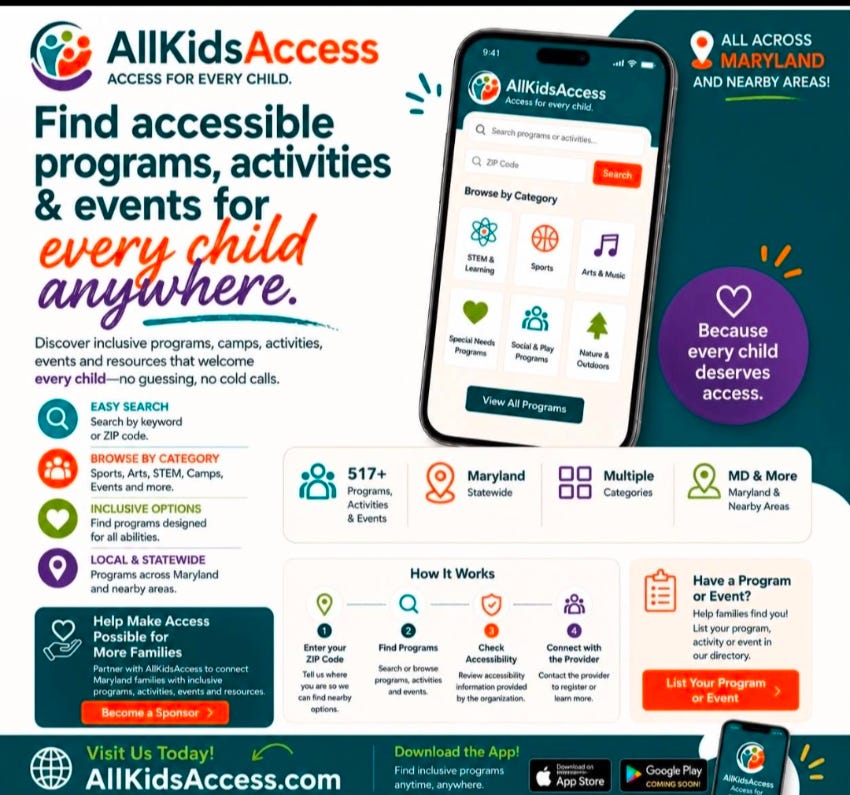
That philosophy is behind his latest initiative, All Kids Access (AllKidsAccess.com), a digital directory and mobile platform designed to make it easier for parents and caregivers to find youth activities, programs, and resources—with accessibility and inclusion at the forefront.
Inspired by a Father’s Journey
For Tilghman, All Kids Access is more than a technology project. It is personal.
The idea grew from his experience as a father after his daughter, Amari, was diagnosed with autism. As he searched for activities and programs she could enjoy, he discovered how fragmented and time-consuming the process could be.
“As a father of a child with autism, I often have to look in multiple places for programs,” Tilghman said. “And even when you find something, you may discover that it isn’t the type of activity your child would enjoy or be able to participate in fully. Accessibility and inclusion have to be priorities for families like mine.”
That experience led Tilghman to ask a larger question: If finding the right programs was this difficult for his family, how many other parents were facing the same challenge?
Instead of simply accepting the problem, he decided to build a solution.
Tilghman spent approximately seven months developing All Kids Access as a centralized resource where families can more easily discover programs based on their location, interests, and accessibility needs.
Making the Search Easier for Families
All Kids Access is designed to reduce the amount of time parents spend searching across multiple websites, social media pages, community calendars, and other sources.
Families can search by ZIP code or county to discover nearby activities and resources. They can also explore programs based on accessibility considerations, including wheelchair accessibility, sensory-friendly environments, and the availability of specialized support.
Program categories include youth sports, STEM and educational activities, visual arts, music, social programs, outdoor activities, and other enrichment opportunities.
Organizations, nonprofits, businesses, and other youth program providers can also submit their programs to the platform and provide information about the services and accessibility features they offer.
Tilghman emphasizes, however, that the name All Kids Access is intentional.
While the platform was inspired by the challenges families of children with disabilities can encounter, it is not exclusively for children with disabilities.
“This is for all kids,” Tilghman said. “Every family should be able to find opportunities for their children, and families who have specific accessibility needs should be able to get better information about those opportunities before they arrive.”
Building a Community of Access
Tilghman sees All Kids Access as more than a directory. He hopes it will encourage organizations that serve young people to think more intentionally about accessibility and inclusion.
The platform creates an opportunity for families and program providers to connect while giving organizations another way to reach parents who may never have discovered their services otherwise.
The goal is not to promise that every program can accommodate every child’s individual needs. Instead, All Kids Access provides families with a better starting point and encourages direct communication between parents and providers.
For Tilghman, that distinction is important.
Parents know their children best. Giving them more information allows them to make informed decisions about which opportunities may be appropriate for their families.
Starting in Maryland, With a Larger Vision
All Kids Access launched in August, beginning its rollout in Maryland.
Families can access the platform through AllKidsAccess.com, and an iOS app is available through Apple’s App Store. A Google Play version is also in development.
Tilghman’s long-term vision extends beyond Maryland. As more families and organizations participate, he hopes the model can eventually expand into communities across the country.
But the mission will remain the same: make it easier for families to find opportunities where children can participate, learn, explore, and belong.
For Tilghman, the project also represents a continuation of the philosophy that has guided much of his community work.
Elections determine who holds office. They do not determine who can serve.
Whether through youth programs, education advocacy, community initiatives, or technology designed to help parents, Tilghman says his commitment to families continues regardless of what title appears before his name.
“Service has no title,” he said. “If you see a problem affecting families and you have the ability to help solve it, you should.”
With All Kids Access, Tilghman is putting that philosophy into practice—turning one father’s search for better opportunities for his daughter into a resource designed to help families across Maryland and, eventually, across the country.
Learn more: AllKidsAccess.com