

Maryland’s Next Big Housing Idea Might Be Hiding Above a Costco
By Barry O’Connell — Maryland Wire
Maryland is heading into its busy season. The General Assembly hasn’t gaveled in yet, but the real work has already begun: bill drafting, coalition‑building, and the annual scramble to turn good ideas into law before the window closes. Every year, a few proposals break through the noise because they solve a problem people can feel in their bones.
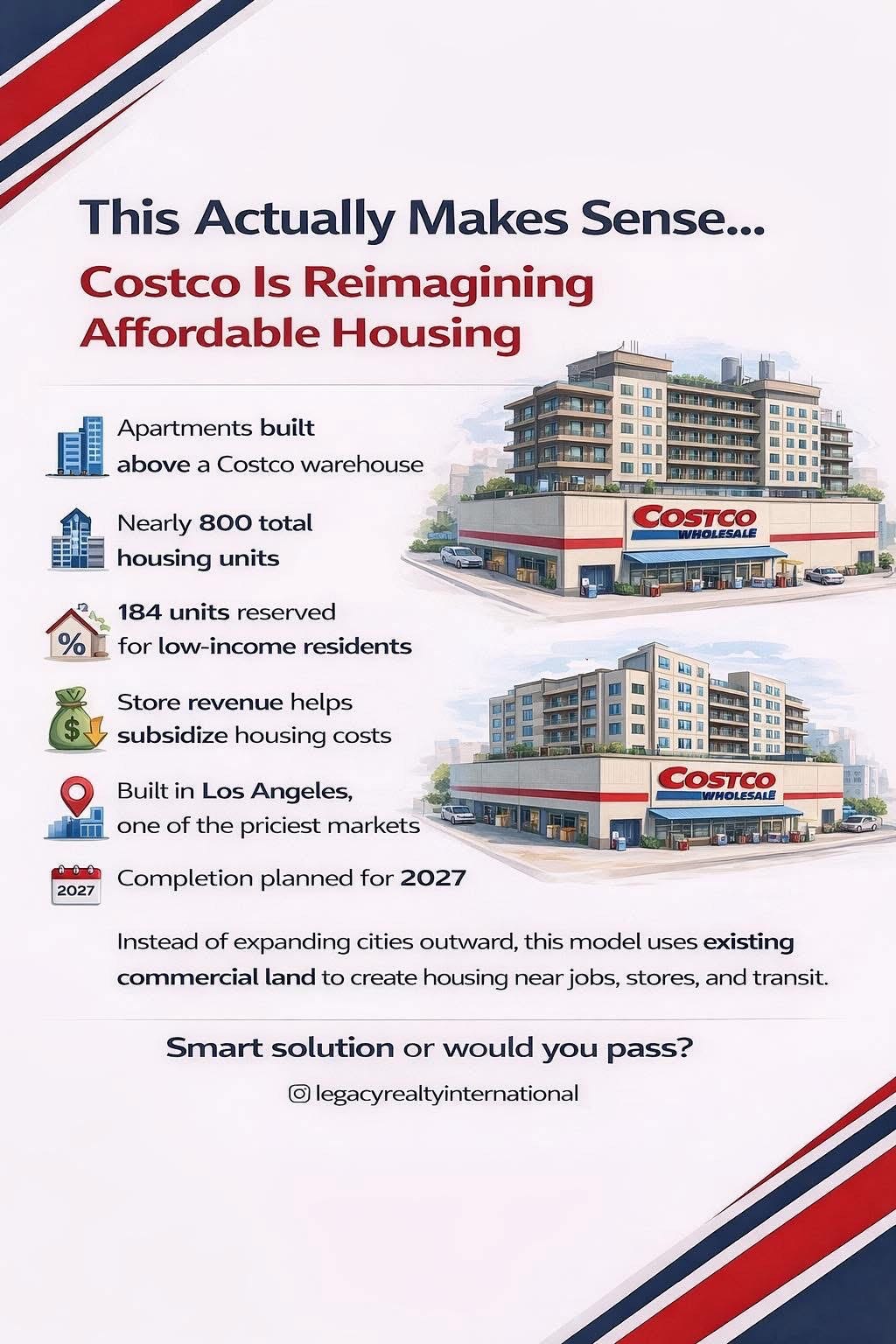
This year, one of those ideas might come from an unlikely place:
the roof of a Costco in Los Angeles.
Yes — a Costco.
And yes — housing on top of it.
It sounds like a novelty until you look closer. Then it starts to look like a blueprint.
A National Problem With Local Consequences
Maryland’s housing shortage isn’t theoretical. It’s the reason young families can’t buy their first home, the reason teachers and nurses commute an hour each way, the reason rents keep rising faster than wages. Every county feels it. Every legislator hears about it. And every year, the gap between what Maryland needs and what Maryland builds gets wider.
We’ve tried incentives. We’ve tried zoning tweaks. We’ve tried pilot programs. But the math keeps coming back the same:
We don’t have enough land zoned for the kind of housing people actually need.
Meanwhile, acres of commercial land — strip malls, big‑box stores, parking lots, aging retail corridors — sit underused or half‑empty.
California looked at that mismatch and passed a law called AB 2011, which allows housing to be built on commercially zoned land if developers meet affordability and labor standards. The result? The first project to break ground is an 800‑unit housing development built directly above a brand‑new Costco in South Los Angeles.
It’s not a gimmick. It’s a model.
Why This Matters for Maryland
Maryland has the same ingredients California had:
- A housing shortage
- A surplus of aging commercial corridors
- Counties struggling to meet housing targets
- Developers who want predictability
- Unions who want good jobs
- Residents who want affordability without sprawl
What we don’t have — yet — is a statewide framework that lets housing be built on commercial land without years of zoning fights.
That’s where the Costco model becomes more than a curiosity. It becomes a policy opportunity.
The Simple Insight Behind a Big Idea
The genius of the California approach is that it doesn’t touch single‑family neighborhoods. It doesn’t force density where people don’t want it. It doesn’t raise taxes. It doesn’t require massive new spending.
It simply says:
> If you want to build affordable or mixed‑income housing on land already zoned for retail or commercial use — and you meet labor and affordability standards — the state will give you a predictable, streamlined path to approval.
No appeals.
No multi‑year hearings.
No death‑by‑delay.
Just clear rules, clear expectations, and clear benefits.
For Maryland, that’s a game‑changer.
Imagine the Possibilities Here at Home
Picture a dead strip mall in Glen Burnie becoming 300 units of mixed‑income housing above ground‑floor retail.
Picture a half‑empty shopping center in Prince George’s County becoming a transit‑connected community with affordable units and union‑built construction.
Picture a warehouse corridor in Baltimore County becoming workforce housing for teachers, firefighters, and hospital staff.
Picture a Costco‑style project in Montgomery County or Frederick — retail on the bottom, homes on top, affordability built in.
This isn’t fantasy. It’s zoning.
And zoning is policy.
Why This Could Actually Pass in Annapolis
Maryland’s political landscape is uniquely suited for this kind of bill:
- Democrats want affordability and smart growth.
- Labor wants prevailing wage construction.
- Developers want predictability.
- Counties want help meeting housing mandates.
- Retailers want redevelopment options.
- Residents want solutions that don’t bulldoze neighborhoods.
A bill modeled on AB 2011 threads that needle.
It doesn’t force density into single‑family areas.
It doesn’t override local control except in narrow, commercial‑only cases.
It doesn’t cost the state billions.
It doesn’t raise taxes.
It simply unlocks land that’s already paved, already developed, and already zoned for activity.
Maryland’s Moment to Lead
The General Assembly is about to enter its season of ideas. Some will be symbolic. Some will be recycled. Some will be dead on arrival.
But every year, one or two proposals rise above the noise because they solve a real problem with a real solution that real people can understand.
A Maryland version of the Costco‑housing model could be one of those ideas.
It’s practical.
It’s scalable.
It’s bipartisan‑friendly.
It’s union‑friendly.
It’s county‑friendly.
And it’s exactly the kind of forward‑looking, common‑sense policy Marylanders are hungry for.
The housing crisis won’t fix itself.
But the land to fix it is already sitting there — under our feet, behind our stores, and in the parking lots we stopped using years ago.
All we need now is the law that lets us build.
Costco is trying to build new, in Bel Air. As a matter of fact, across the street from the proposed Comptroller's office. Can Harford Countians expect this version of affordable housing units?
Interesting. I always like Richard Florida’s take on related policy. Although Maryland never seems to be cited for creative problem solving across any sector, preferring to foot drag and coddle legacy frameworks, to its detriment. The state talks a huge game. But the rubber rarely meets the road. But hey! Maybe another commission to evaluate the problem, to create a committee to then vote to use tax payer dollars to fund an out of state consultant to turn in a report that states the obvious or entirely misses the mark. Yup. That’s the Old Line state.