


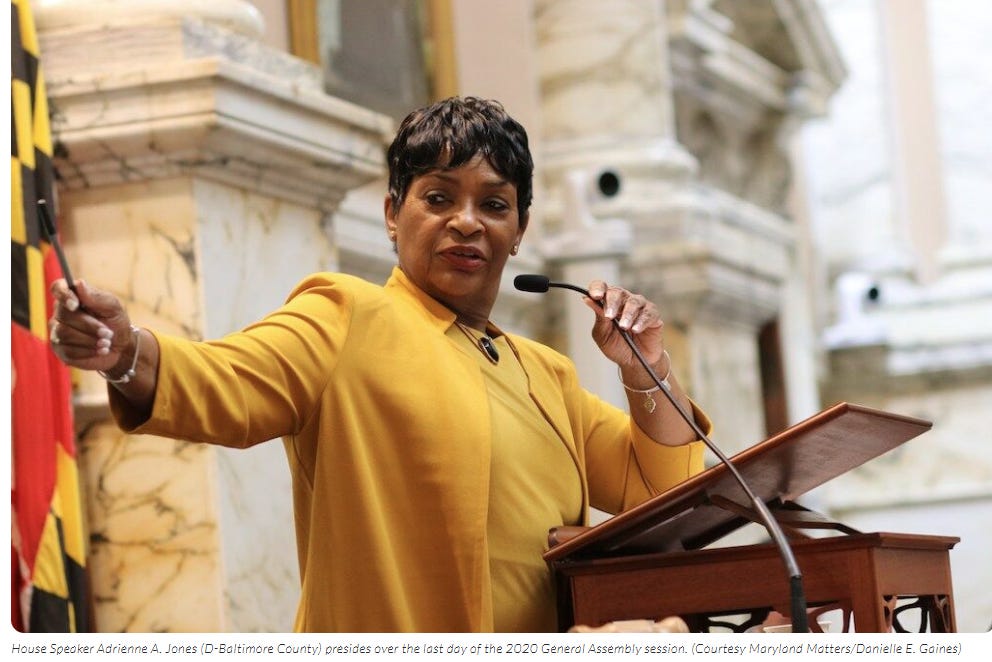
In a year marked by personal tragedy and political turbulence, Maryland House Speaker Adrienne A. Jones has emerged not just as a survivor—but as a steward of integrity. While others maneuvered for advantage, Jones governed with restraint, legality, and a quiet moral force that has become increasingly rare in Annapolis.
⚖️ A Lawful Steward in a Fractured Capitol
Jones’s leadership this session was defined not only by policy wins, but by how she won them:
- No backroom deals. No procedural games. Jones ran the House by the book, even as the chamber faced a $3 billion deficit and intense pressure from lobbyists and interest groups.
- She resisted the urge to centralize power, instead empowering committee chairs and respecting the legislative process—a stark contrast to the Senate’s more opaque maneuvering.
- Her “Decency Agenda”, which protected access to books and information in schools and libraries, was passed without drama or delay. It was principled, not performative.
Jones’s reputation as an honest broker has only grown. She’s known for saying “no” when others expect a quiet “yes,” and for refusing to bend the rules even when expediency beckons. Her colleagues describe her as “fair,” “decent,” and “unshakably lawful”—terms rarely applied to Maryland’s political elite.
🔍 A Growing Contrast: Ferguson Under Fire
While Jones has kept her hands clean, Senate President Bill Ferguson is facing mounting scrutiny:
- Ferguson’s dual role as a lawmaker and senior legal counsel for CI Renewables—a Baltimore-based solar energy firm—has raised serious conflict-of-interest concerns.
- He voted on energy legislation that could directly benefit his employer, including the Renewable Energy Certainty Act, which fast-tracks solar panel deployment across Maryland farmland.
- Ethics filings show Ferguson acknowledged potential financial gain from contracts negotiated by CI Renewables with local governments.
- Critics, including Del. Mark Fisher, have called it “a solar grift,” urging Ferguson to recuse himself from energy votes entirely.
While Ferguson insists he can act “fairly, objectively, and in the public interest,” the optics are troubling. His actions have sparked calls for greater transparency and raised questions about whether Maryland’s energy policy is being shaped by private interests.

🧭 Jones’s Post-Session Focus: Equity, Education, and Federal Readiness
Since the session ended, Jones has continued to lead with clarity:
- She’s drafting new social equity legislation to support historically disadvantaged communities.
- She’s drawn a firm line against cuts to the Blueprint for Maryland’s Future, insisting that education investments must build real capacity.
- She’s preparing the House to counteract potential federal rollbacks under the Trump administration, especially in healthcare and minority business programs.
In a year when Maryland politics felt increasingly transactional, Speaker Adrienne Jones stood out—not just for what she accomplished, but for how she did it. Her leadership wasn’t flashy, but it was principled. And in a moment when the Senate’s top lawmaker faces ethical questions, Jones’s lawful stewardship offers a quiet rebuke—and a model worth emulating.