

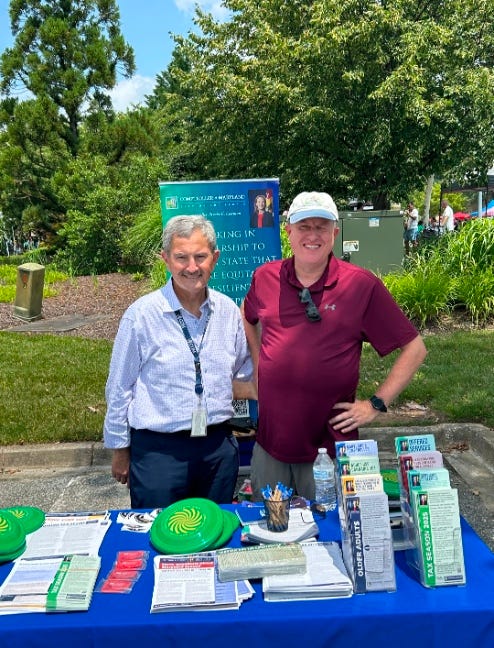
David Marks with the Godfather Clem Kaikis
Councilman David Marks stands on the cusp of history, poised to become only the second representative from Baltimore County’s Fifth District to secure a fifth term. The first was Vince Gardina, a Democrat and environmental stalwart who served from 1990 to 2010. Both men hail from Perry Hall, both have shaped the district’s trajectory, and both have earned reputations for independent thinking. But their paths, and their political climates, differ sharply.
Gardina vs. Marks: Similar Roots, Divergent Roads
- 🏛️ Tenure & Legacy
Gardina’s two-decade run was marked by environmental advocacy, zoning reform, and a fierce commitment to sustainability. He reshaped Perry Hall’s development patterns and later served as Director of Environmental Protection for the county.
Marks, a Republican, has served since 2010 and built his brand on bipartisan cooperation, education reform, and historic preservation. He’s credited with pushing for new parks, schools, and open-space zoning.
- 🎓 Backgrounds
Gardina was a former police officer turned environmental engineer, with degrees in geography, computer science, and environmental engineering.
Marks holds degrees in government, public policy, and teaching, and has worked in transportation policy at both state and federal levels.
- 🧭 Political Style
Gardina was known for his tenacity and willingness to buck party lines — even suing the Ehrlich administration over a politically motivated firing.
Marks has cultivated a reputation for pragmatic leadership, but now faces a defining test of principle.
The Redistricting Crossroads
As Baltimore County expands its council from seven to nine districts, the redistricting process has become a litmus test for racial equity and democratic representation. Currently, Black voters make up over 44% of registered Democrats in the county, yet hold only one of seven council seats. That imbalance is not just statistically glaring — it’s structurally unjust.
Councilman Marks now faces what may be the only serious cloud over his otherwise steady career: his role in shaping the new council map. If he fails to support a redistricting plan that empowers Black voters to elect candidates of their choice, he risks being cast, fairly or not, as an obstructionist to racial equity. The optics are stark: inaction or resistance could be interpreted as tacit support for maintaining white political dominance, even if Marks himself does not espouse such views. One of the biggest issues is that when David MARKS says “ACTIVISTS” many people white and black think it's a dog whistle for “uppity n******”. That would not be characteristic at all for David Marks, but that's the way it's being spun on both sides. Black folks are starting to feel that his stand is racist
The Political Cost of Inaction
- 💸 Potential Fallout: A failure to support an inclusive map could invite a well-funded challenge, with outside groups pouring resources into unseating him.
- 🗳️ Voter Backlash: With demographic shifts and rising awareness, voters are increasingly attuned to representation. Ignoring their voices could cost Marks his seat.
- 🧭 Moral Imperative: Leadership demands more than policy wins — it requires moral clarity. Supporting a fair map isn’t just politically smart; it’s ethically necessary.
A Message to Councilman Marks
This is a moment to lead boldly. If more than a third of Baltimore County’s voters are Black, then the council map must reflect that reality. Slicing and dicing communities into diluted districts perpetuates disenfranchisement. But a fair, representative map would not only honor democratic principles, it would secure Marks’ legacy and likely his fifth term.
The choice is his. The consequences will be collective.