

Coalition Building in Maryland: Qawms, Qawmics, and the Politics of Belonging
Intro:
In Maryland politics, we often talk about “challenging everywhere.” It’s a sound instinct — you can’t win if you don’t contest. But challenging everywhere is not enough. To understand why some candidates thrive while others falter, we need to look deeper into the sociology of coalition building. That’s where the concepts of quam and quamic come in.
(Qawm is an Arabic term I first encountered in Central Asia. In places like Afghanistan, Iran, and the Persian Gulf, it’s used to describe groups bound by shared skills, trades, or identities. People sometimes assume I was a spy for working in those regions — but I could never work for the CIA. I don’t even know how to spell it. Keeping secrets is too difficult, except perhaps in Maryland politics.)
🧩 What Is a Qawm?
A Qawm is any group identity that binds people together:
- Occupation (farmers, shopkeepers, teachers)
- School ties (the graduating class of a local high school)
- Neighborhood identity (living in a particular part of town)
- Faith communities (churches, synagogues, mosques)
- Clubs and hobbies (rod and gun clubs, fishing groups, civic associations)
The longer someone has lived in a community, the more Qawms they accumulate — and the stronger their natural coalition becomes.
🔗 What Is a Qawm?
A Qawmic is the larger coalition that emerges when multiple Qawms coalesce into something more organized and durable.
- Farmers and chicken growers in rural districts form a natural quamic.
- Business owners in a town form another.
- Faith communities often overlap with occupational quams, reinforcing solidarity.
These Qawmic confederations are the ballast of local politics. They provide stability, resources, and predictability.
⚖️ Challenge Races vs. Anchor Races
- Challenge races depend on cross‑Qawm coalitions. A challenger must stitch together groups that don’t naturally align — teachers, reformers, small shopkeepers — into a temporary alliance strong enough to unseat an incumbent. These coalitions are fragile but dynamic.
- Anchor races lean on Qawmic confederations. Incumbents or strong favorites rely on naturally occurring blocs — farmers, business owners, professionals — whose shared identity and interests give them ballast and stability.
🌾 Rural Maryland and the Power of Qawms
In rural districts, occupational Qawms matter deeply:
- A farmer running for delegate on the Eastern Shore has a natural Qawmic advantage.
- An apple grower in Western Maryland taps into the same occupational solidarity.
- By contrast, a candidate running a new age bookshop in those districts may struggle to find a natural Qawm That doesn’t mean they shouldn’t run — but it does mean they face a steeper climb, relying on fragile cross‑Qawm coalitions rather than natural confederations.
🎯 The Strategic Lesson
Steuart Pitman’s call to challenge in every location is right — but it’s incomplete. Challenging everywhere is necessary, yet the real key is challenging with candidates who embody the Qawms of their community. Candidates with deep ties — layered quams built from occupation, school, neighborhood, faith, and civic life — are far more likely to prosper and thrive.
Coalition building is not just about geography. It’s about sociology. The ties that bind us to our communities are the wedge blocks of politics. Candidates who live inside those Qawms don’t have to invent coalitions; they are coalitions.
🪞 Closing Reflection
Maryland politics is full of surprises, but one truth endures: the strongest candidates are those who belong. They are the ones whose lives intersect with the Qawms of their district, whose identities resonate across multiple groups, and whose presence feels inevitable. Challenging everywhere is the first step. Challenging with candidates who embody their community’s Qawms is how you win.
N.B. I wrote this second part first and then the concept of Qawm occured to me. When I was studying Afghan civilization for 25 yeaars it wa a vital tool and it occured to me that it applied to Maryland as well. In Arabic Qawm means people or nation. But in Central Asia in Urdu, Pashto, and Dari, it refers to your slice of society, so I use it in that sense.
🗂 Updated Strategic Notes
1. Virginia Proof of Concept
- Spanberger’s victory: In November 2025, Abigail Spanberger defeated Republican Lt. Gov. Winsome Earle‑Sears with nearly 57% of the vote, the largest margin for a Democrat in decades.
- Red‑to‑blue impact: Spanberger’s campaign flipped multiple suburban and exurban districts, showing how trained, pragmatic candidates can carry battlegrounds.
- Bellwether: Her win is seen nationally as a rebuke of Trump’s second term policies and a signal for 2026 midterms.
2. Maryland Context
- Steuart Pittman’s strategy: As incoming Maryland Democratic Party chair, Pittman has pledged to contest every race statewide in 2026, including the Eastern Shore and Western Maryland.
- Objective: Force Republicans to defend turf everywhere, drain their resources, and prevent “safe zones.”
3. Coalition Dynamics
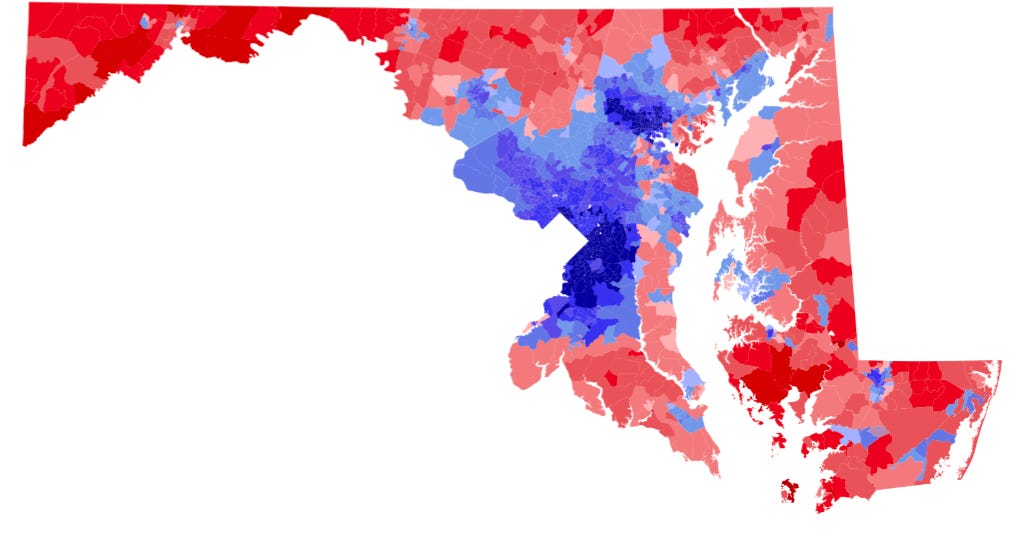
- Strengths of the new coalition: Women, LGBTQ+, and diverse candidates perform strongly along the I‑95 corridor (Baltimore, Prince George’s, Montgomery counties) where working‑class and college‑educated voters overlap.
- Limitations: In Eastern Shore and Western Maryland, voters often respond better to candidates who reflect traditional community norms — “neighbors they recognize.”
- Strategic question: Can Emerge adapt its training to prepare traditional women candidates who resonate in rural Maryland, while still maintaining its broader coalition?
4. Gender Balance in Candidate Recruitment
- Concern raised: Some Democratic strategists argue there’s “nothing wrong with a Democrat who can piss standing up” — shorthand for saying men bring visible strength and shouldn’t be excluded.
- Balance point: While Emerge focuses on women, Maryland Democrats must ensure men are not discouraged from running. A mix of women in challenge positions and men in anchor races could strengthen the overall slate.
- If the goal is really contesting every race, then we can’t sidelining any demographic. Women trained by Emerge can lead in many districts, but men must remain part of the equation.