

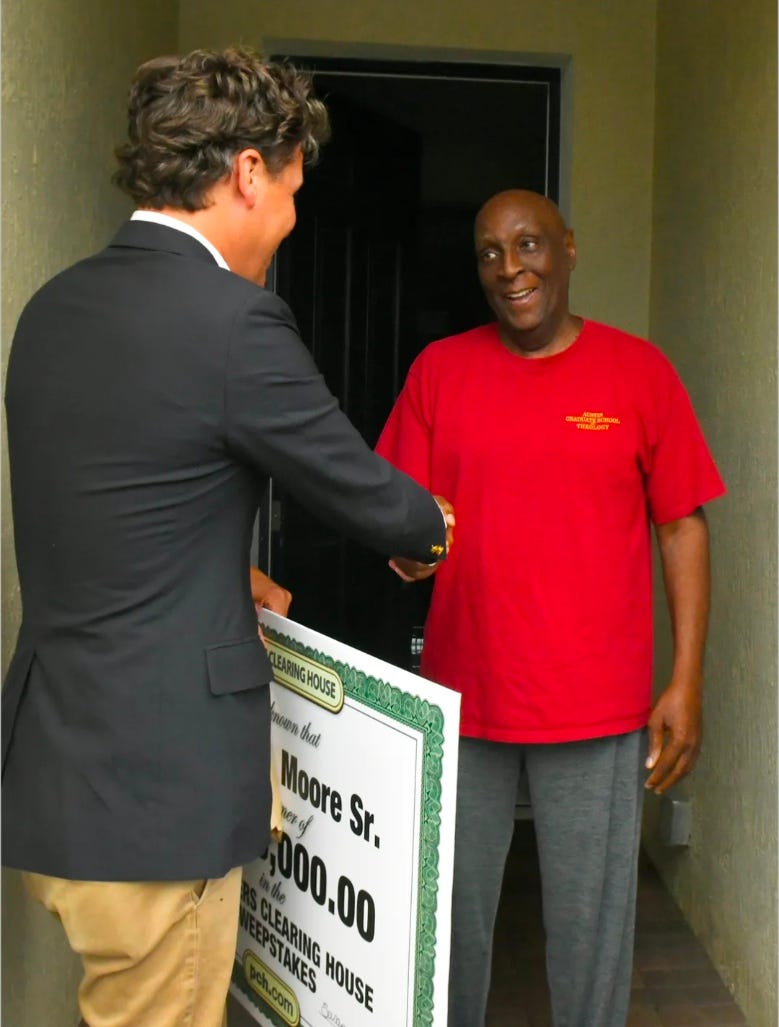
When people imagine reparations many people imagine it like when publishers clearing House came to this man’s home to present him with a giant check. But who gets the check? And where does the money come from?
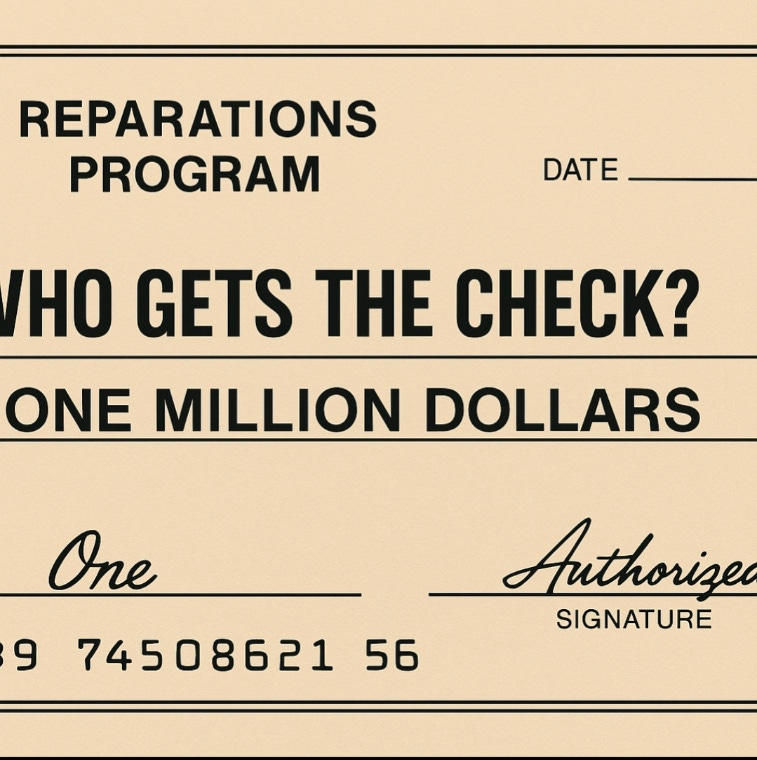
Thought experiment: What does a “million dollar reparations check” really cost?
A lot of people hear “reparations” and picture the Publishers Clearing House moment: someone shows up at your door with a giant million‑dollar check, cameras rolling, Happy Black Family™ gets life‑changing money, fade to credits.
What almost nobody wants to think about is: that money has to come from somewhere.
So here’s a serious math exercise built around a deliberately extreme, even lunatic, idea.
Step 1: Assume a very generous Maryland reparations plan
- Everyone who can prove they’re descended from someone enslaved in Maryland gets a \$1,000,000 check.
- For this thought experiment, assume about 9.8% of Marylanders qualify as descendants of people enslaved in Maryland.
- That 9.8% pays nothing into the fund. They are exempt.
- Everyone else pays for it:
- White, Black, Asian, Latino, immigrant, mixed race…
- Even Black families whose ancestors were enslaved in Virginia or South Carolina, not Maryland.
- If you’re not descended from someone enslaved in Maryland, you pay.
We’re not arguing this is a good or fair plan. We’re using it to show there is no such thing as “free” million‑dollar checks.
Step 2: Total cost of the program
- Let’s call:
- \(f = 0.098\): the 9.8% who qualify as “Maryland‑enslaved descendants”.
- \(R = \$1{,}000{,}000\): the reparations check each of them gets.
- Number of recipients:
\[ 0.098 \cdot P \]
where \(P\) is the total population.
- Total cost:
\[ 0.098 \cdot P \cdot \$1{,}000{,}000 \]
Step 3: Who pays, and how much per person?
Only the other 90.2% of Marylanders pay:
- Paying population:
\[ 0.902 \cdot P \]
Per‑person bill for non‑exempt people is:
\[ \text{Per-person bill} = \frac{0.098 \cdot P \cdot \$1{,}000{,}000}{0.902 \cdot P} \]
The \(P\) cancels out:
\[ \text{Per-person bill} = \frac{0.098}{0.902} \cdot \$1{,}000{,}000 \approx 0.108648 \cdot \$1{,}000{,}000 \approx \$108{,}648 \]
So under this model:
> Every Marylander who is not descended from someone enslaved in Maryland would owe roughly \$108,648.
That includes:
- White Marylanders.
- Black Marylanders whose ancestors were enslaved somewhere else (Virginia, the Carolinas, etc.).
- Everyone who doesn’t meet that very specific ancestry test.
Step 4: Now apply that to real families
In this thought experiment, each person is one “share.”
- Single adult, no kids:
- Owes 1 share
- Roughly \$108,648
- Family with 2 parents and 7 kids (9 people total):
- Owes 9 shares
\[ 9 \cdot \$108{,}648 \approx \$977{,}832 \]
So that big, glossy one‑million‑dollar check for the qualifying neighbor?
- Their family (if they qualify as descendants of Maryland‑enslaved people) pays \$0 and collects \$1,000,000.
- The non‑qualifying family across the street (even if they’re Black, but their ancestry traces to Virginia or South Carolina) might get a bill for around \$977,000.
Again: I am not saying this is a serious policy proposal or that this is what Maryland should do. The point is to make the cost structure visible.
There is no version of “everyone gets a million dollars” where the money just appears out of thin air. Someone pays. The only real questions are:
- Who pays?
- Who collects?
- How do we justify that line?
I’m curious: when people say they support “reparations,” are they imagining this kind of math? Or are they imagining Publishers Clearing House with no bill attached?
It’s amazing in this day and time for “whites” to be sooo concerned about the cost of atrocities inflicted that made this nation filthy rich- without the free labor you wouldn’t be touting your economic might! But you refuse to pay for the work done for free! Stop with your silly inhumane nonsense!
No one in my family owned slaves. Entire family came from West Virginia in 1939 to work at Martins Factory in Middle River Maryland. We weren’t here in MD during the Civil War.