

90 Seconds to Save Lives:
How Maryland’s Pilots Prevented an Even Greater Tragedy
By Barry O’Connell
At 1:25 a.m. on March 26, 2024, the 984-foot container ship Dali suffered a catastrophic total loss of electrical power while moving outbound through Baltimore Harbor. In an instant, the massive 95,000-ton vessel lost propulsion and steering capability while dead-reckoning directly toward a support pier of the Francis Scott Key Bridge.
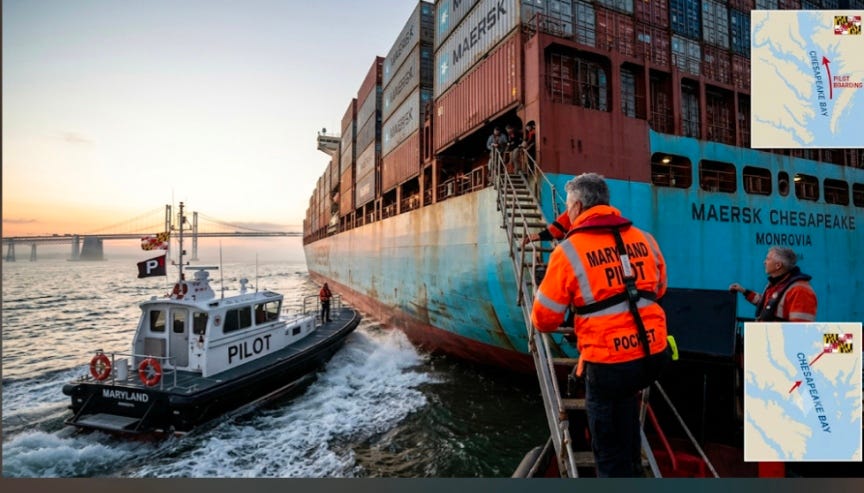
On the bridge of the Dali were two state-licensed harbor pilots from the Association of Maryland Pilots. What unfolded over the next 90 seconds was a masterclass in crisis management, emergency protocol, and rapid decision-making under extreme duress.
The Mayday That Kept Cars Off the Bridge
When total blackout hit, the pilots did not hesitate. Recognizing that steering was non-responsive, the lead pilot immediately ordered the ship’s port anchor let go to slow momentum and attempt to arrest the vessel’s starboard drift.
Simultaneously, the pilots issued an urgent Mayday broadcast over marine radio. They did not simply report a mechanical failure; they specifically requested that shore authorities halt all vehicular traffic across the Key Bridge immediately.
Dispatched by the Mayday call, Maryland Transportation Authority (MDTA) police officers acted within seconds. Officers stationed at both ends of the bridge locked down access ramps, physically blocking commuters and late-night drivers from proceeding onto the span.
Preventing a Mass-Casualty Disaster
While six dedicated construction workers tragically lost their lives on the span, the pilots’ prompt action prevented dozens of vehicles from driving into the freezing Patapsco River. Had traffic continued flowing normally at 1:28 a.m., scores of commuters would have driven blindly into the dark waters as the bridge collapsed.
Local state-licensed pilots are often the unsung custodians of our waterways. They possess a granular, deep-seated knowledge of local channels, currents, and emergency networks that no foreign ship crew can replicate. In those 90 critical seconds, that local expertise was the only barrier standing between a severe industrial accident and an unimaginable catastrophe.
SUBSCRIBE TO READ THE FULL POLICY ANALYSIS & PILOT GOVERNANCE REPORT
================================================================================
Professional Analysis:
Rethinking Transit Scope, Tug Escorts, and Maryland Governance
Thank you for supporting our independent maritime reporting. Below is our deep dive into the regulatory reforms, escort protocols, and governance changes required to safeguard Chesapeake infrastructure.
The Myth of the “Harbor Limit”: Why Leaving the Berth Isn’t the Safe Zone
For decades, maritime harbor operations treated a ship’s departure as a two-stage process: an intensive maneuver away from the berth, followed by routine transit once aligned in the channel. Historically, tugboats assisted large vessels out of the slip and peeled off once the ship reached open channel water.
The Dali disaster exposed a fatal flaw in this assumption.
Navigating a 1,000-foot ultra-large container ship through a 50-foot deep channel with only 2 feet of under-keel clearance leaves zero margin for error. An ocean-going vessel remains in a high-consequence critical transit phase for every mile it travels under or past major fixed infrastructure—including both the Patapsco crossings and the Chesapeake Bay Bridge downstream near Annapolis.
Leaving these vessels to navigate under their own power through narrow bridge passages assumes continuous mechanical reliability. As the Dali proved, when electrical or propulsion systems fail, a 100,000-ton hull cannot be stopped or steered by its bow anchor alone.
Policy Reform: Mandatory Tethered Escorts Past All Major Infrastructure
The single most impactful operational change needed in Maryland waters is a mandate for tethered tug escorts throughout the entire bridge transit corridor.
Active vs. Standby Escorts: In many international ports, tugs do not merely follow a vessel; they remain physically attached to the stern via high-strength towlines until the ship clears all critical bridges and narrow channels.
Physical Redundancy: If a ship suffers a complete blackout, a tethered escort tug provides instant steering vector control and braking torque—acting as an external rudder and brake system independent of the vessel’s onboard power grid.
While shipping lines frequently push back against the operational cost of extended tug escorts (often citing tens of thousands of dollars per transit), the $2B+ economic destruction caused by a single bridge strike renders that cost argument obsolete.
Maintaining Local Command: Empowering Maryland Pilots
Foreign-flagged merchant vessels arrive in local waters with crews operating under intense fatigue, foreign language barriers, and varying maintenance standards. State law requires local pilots for a reason: public safety and environmental protection over commercial speed.
To protect regional infrastructure, state authorities and maritime commissions should focus on three policy imperatives:
Expanding State Pilot Jurisdiction & Mandate:
Explicitly empowering Maryland Pilots to delay or deny passage to any vessel exhibiting power fluctuations or equipment anomalies prior to entering bridge transit corridors.
Standardized Escort Directives:
Codifying joint Coast Guard and Maryland Pilot rules that require heavy escort tugs to remain tethered until ships clear both the Baltimore Harbor structures and the Bay Bridge approaches.
Dedicated Emergency Comms Channels: Establishing direct, dedicated electronic and radio linkage between state pilot bridge teams, local port dispatch, and state highway police to eliminate any latency in emergency bridge shutdowns.
Guiding ocean-going giants out of the dock is only the start of the job. Until these vessels clear our most vital public bridges, Maryland’s pilots must be equipped with the physical leverage, regulatory backing, and tug support needed to keep our waterways secure.