

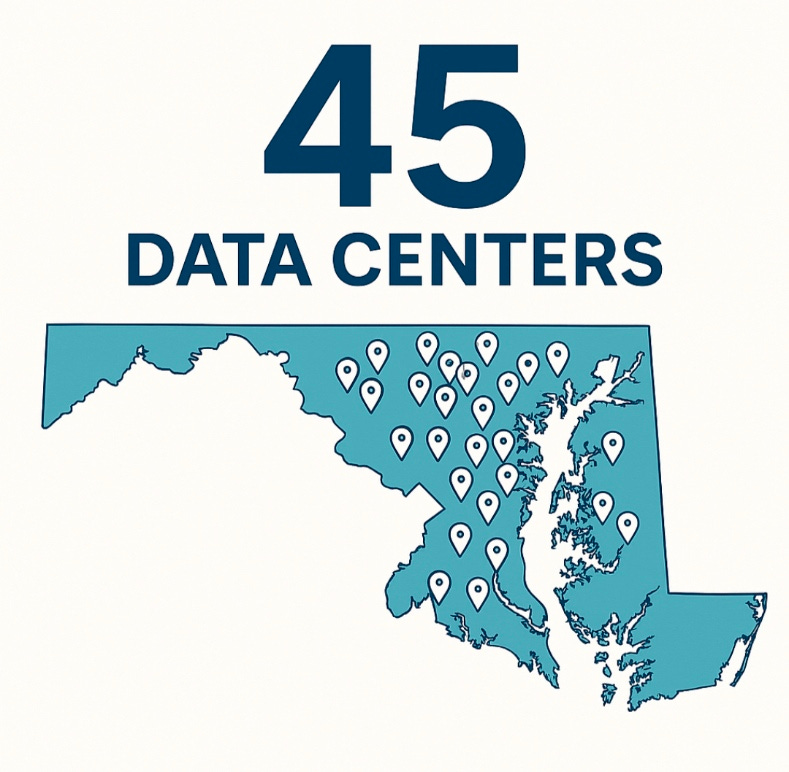
THE QUIET FORTY‑FIVE
Inside Maryland’s Hidden Network of 45 Data Centers
By Barry O’Connell
Maryland’s data‑center landscape doesn’t announce itself the way Northern Virginia’s does. There are no endless rows of hyperscale boxes along the highway, no skyline of cooling stacks glowing at night. Instead, Maryland’s 45 data centers are woven into the state’s existing fabric — tucked into Baltimore’s industrial blocks, embedded in Silver Spring’s office parks, hidden behind the security perimeters of Aberdeen and Annapolis Junction.
They form a digital ecosystem that is quieter, older, more federal, and far more eclectic than most readers realize. And that’s exactly what makes them interesting.
A State Built for Data — Even If It Doesn’t Look Like One
Maryland’s geography is destiny.
The state sits at the intersection of:
- Federal agencies
- Defense contractors
- Biotech and research corridors
- Major fiber routes
- Port‑driven commerce
That combination produced a data‑center map unlike any other on the East Coast: not a single massive cluster, but six distinct micro‑regions, each with its own personality and history.
1. Baltimore: The Industrial Backbone
Baltimore hosts more than a dozen data centers, many of them built into the bones of the city’s telecom and industrial past.
What stands out
- AiNET One Market Center — a former telecom hub turned high‑security digital fortress.
- DataBank BWI1 — a carrier‑dense downtown facility with deep fiber access.
- TierPoint Baltimore — a modernized, enterprise‑friendly site near the stadium district.
- COPT Defense Properties — discreet buildings serving federal and defense workloads.
Why readers care
Baltimore’s data centers are architectural palimpsests — old buildings with new missions. They reflect the city’s evolution from maritime commerce to digital infrastructure.
How long they’ve been here
Most date from the late 1990s to early 2010s, built on top of legacy telecom switching sites.
2. The BWI–Linthicum Corridor: Maryland’s Digital Spine
If Baltimore is the industrial heart, the BWI corridor is the nerve center.
Key players
- TierPoint BWI
- COPT’s Winterson Road and Elkridge Landing Road campuses
- Defense‑adjacent facilities near Fort Meade
Why it matters
This corridor sits between the airport, the interstate, and the intelligence community. It’s one of the most fiber‑rich stretches of land in the state — a perfect place for secure, low‑latency compute.
Age profile
Most facilities here were built or expanded in the 2000s and 2010s, tracking the explosive growth of Fort Meade and NSA.
3. Silver Spring: The Federal Edge Zone
Prosperity Drive in Silver Spring is one of Maryland’s most surprising data‑center clusters — a quiet pocket of compute power just outside the Beltway.
Notable sites
- ByteGrid MDC1 & MDC2
- DataBridge Silver Spring
- Lincoln Rackhouse facilities
Why it’s interesting
These buildings began life as office or research facilities before being hardened into data centers. They serve federal agencies, contractors, and D.C.‑area enterprises that need proximity without the constraints of downtown Washington.
Age profile
Most were converted in the 2000s, with modernization waves in the 2010s.
4. Frederick County: The Hyperscale Frontier
Frederick is Maryland’s most forward‑looking data‑center region.
The headline project
- Aligned Data Centers Hyperscale Campus — one of the few true hyperscale‑ready sites in the state.
Why it matters
Frederick has what hyperscalers crave:
- Land
- Power availability
- Zoning flexibility
- Distance from dense urban cores
This is where Maryland’s next decade of data‑center growth will happen.
Age profile
These are 2020s‑era developments — the newest in the state.
5. Rockville, Germantown & Beltsville: The Suburban Triad
Montgomery and Prince George’s counties host a constellation of smaller, specialized facilities.
Representative examples
- Mosaic Data Services (Rockville)
- AiNET Beltsville
- Germantown’s single‑facility node
Why they’re interesting
These centers serve biotech, research, and suburban enterprise clients. They’re smaller, more specialized, and often tied to scientific or medical workloads — a reflection of the region’s economic identity.
Age profile
Mostly 2000s‑era conversions and purpose‑built sites.
6. Aberdeen & Annapolis Junction: Defense Country
These are the most security‑sensitive data centers in Maryland.
Key facilities
- COPT Aberdeen Research Boulevard
- COPT National Business Parkway (Annapolis Junction)
Why they matter
These buildings support defense, intelligence, and cybersecurity missions. They’re low‑profile by design — the kind of places that look like ordinary office parks until you notice the badge readers, bollards, and fiber vaults.
Age profile
Primarily mid‑2000s to mid‑2010s, built in tandem with the post‑9/11 expansion of the intelligence community.
What Makes Maryland’s 45 Data Centers Truly Interesting
1. They’re hidden in plain sight.
Maryland’s data centers blend into business parks, office towers, and industrial corridors. Most residents drive past them without realizing what they are.
2. They’re deeply federal.
No other state except Virginia has such a tight integration between data centers and national security infrastructure.
3. They reflect Maryland’s economic DNA.
Baltimore’s industrial past, Montgomery County’s biotech future, Anne Arundel’s defense corridor — all of it shows up in the data‑center map.
4. They’re on the cusp of transformation.
Frederick’s hyperscale projects could shift Maryland from a “quiet” data‑center state to a regional heavyweight.